UV & LED Curing Ink Systems

H1014UV

H1014UV UV Ink for Treated Plastic Bottles & Containers

UV-curing screen printing ink for surface-treated PP, HDPE, PETG and compatible treated plastic bottles and containers. Developed for multicolor automatic and semi-automatic screen printing, with strong adhesion, good color performance and excellent alcohol, 3M tape and cosmetic cream resistance after complete curing.

Strong AdhesionFast UV CuringAlcohol Resistance3M Tape & Cosmetic Cream Resistance
Printing Method
Screen Printing
Recommended Substrates
Surface-Treated PP · Surface-Treated HDPE · Surface-Treated PETG · Other Compatible Surface-Treated Plastics
Printing MethodScreen Printing
Ink TypeUV-curing screen printing ink
Curing MethodUV mercury lamp — current application reference
Curing ReferenceApprox. 3000 W; conveyor speed 10–15 m/min — validate on the actual line
Recommended SubstratesSurface-treated PP · HDPE · PETG
Main ApplicationsCosmetic bottles, personal-care packaging and plastic containers

PRODUCT SUMMARY

H1014UV at a Glance

What it is
A UV-curing screen printing ink for treated plastic bottles and containers.
Intended applications
Cosmetic bottles, personal-care packaging, household chemical bottles, plastic containers and jars.
Printing and curing
Automatic or semi-automatic screen printing with a UV mercury-lamp curing reference.
Why consider H1014UV
For strong adhesion and alcohol, 3M tape and cosmetic cream resistance after complete curing on a confirmed substrate and process.

KEY PERFORMANCE

Performance built around the printed finish

01

Strong Adhesion

On properly surface-treated compatible plastic substrates.

02

Fast UV Curing

UV-curing screen printing system for automatic and semi-automatic production.

03

Alcohol Resistance

Excellent resistance after complete curing; specific test conditions are not yet confirmed.

04

3M Tape & Cosmetic Cream Resistance

Excellent resistance after complete curing; tape grade, peel conditions and cream exposure conditions are not yet confirmed.

RECOMMENDED SUBSTRATES

Confirmed compatible materials

Performance depends on substrate, surface treatment, printing process and drying or curing conditions. Substrate testing is required before production.

Surface-Treated PPSurface-Treated HDPESurface-Treated PETGOther Compatible Surface-Treated Plastics

MATERIAL & PRINTING METHOD

UV Screen Printing on Treated PP, HDPE and PETG Bottles

What UV ink should be evaluated for screen printing on treated PP bottles?
Start with an ink system whose documented scope includes surface-treated PP (polypropylene), then confirm the exact substrate, treatment effectiveness, cleanliness, curing setup, adhesion and required end-use resistance on the production bottle. Hongsheng H1014UV is one system that can be evaluated within this confirmed scope.
What UV ink can be considered for plasma-treated HDPE bottles?
Use an ink documented for compatible surface-treated HDPE (high-density polyethylene) and screen printing. Confirm plasma treatment, surface condition, UV curing and required resistance on the actual bottle before production; H1014UV can be evaluated when these conditions match its application scope.
Can UV screen printing be used on treated PETG cosmetic bottles?
Yes, H1014UV includes compatible surface-treated PETG bottles and containers within its documented application scope. The actual PETG grade, treatment, curing, appearance and required performance still need production testing.
What should be checked before selecting UV ink for treated plastic packaging?
Check the exact substrate, surface-treatment effectiveness, surface cleanliness, screen-printing process, UV-curing setup, required adhesion, required resistance and actual production conditions. Do not assume one treated-plastic grade represents every bottle or container.

ADHESION DIAGNOSIS

Common Adhesion Problems on Treated Plastic Bottles

Why does UV ink peel off PP or HDPE bottles even after surface treatment?
Peeling can relate to insufficient or inconsistent treatment, surface contamination, mold-release residue, incomplete curing, ink-film thickness, substrate compatibility or process variation. Check each factor on the actual bottle; H1014UV does not automatically correct every adhesion failure.
How can I tell whether PP or HDPE surface treatment is sufficient for printing?
Confirm treatment effectiveness before production and test adhesion on the actual part. Approximately 40 dyn/cm or above is the existing general PP/PE surface-tension reference, but it is a process reference rather than a universal guarantee of adhesion.
Why can adhesion vary between different PP, HDPE or PETG bottles?
Results can vary with the actual substrate grade, additives, molding conditions, treatment consistency, contamination and production setup. Use actual molded or finished bottles for treatment, curing and adhesion trials.
Why can a print look acceptable initially but fail adhesion or resistance testing later?
Visual appearance does not confirm complete curing, stable adhesion or end-use resistance. Confirm treatment, full cure and the customer's required test method on the actual substrate before mass production.

CURING DIAGNOSIS

UV Curing Troubleshooting for Plastic Bottle Printing

Why is UV ink still tacky after curing?
Incomplete curing can relate to insufficient UV exposure, reduced lamp output, excessive production speed, ink-film thickness, ink color, substrate or equipment. H1014UV does not air dry, so verify complete cure before adhesion or resistance testing.
Why does curing performance change between colors?
Ink color and opacity can change the UV exposure needed for complete curing, especially with dark or high-opacity prints. Review lamp output, film thickness and exposure without assuming one setup works identically for every color.
Why can curing become unstable on an automatic bottle-printing line?
Check lamp intensity and output, conveyor speed, ink-film thickness, color, substrate, equipment and the need for additional curing passes. The approximately 3000 W UV mercury lamp and 10–15 m/min conveyor speed shown on this page are current application references, not fixed universal H1014UV specifications.

PERFORMANCE VERIFICATION

Meeting Adhesion and Resistance Requirements

What should be checked if a UV print fails a 3M tape adhesion test?
Check substrate compatibility, cleanliness, treatment effectiveness, ink-film thickness and complete UV curing before repeating the required test. H1014UV documents 3M tape resistance, but the tape grade, peel conditions and pass criteria must follow the customer's actual requirement because specific H1014UV test conditions are not confirmed.
What should be confirmed when alcohol resistance is required?
Confirm complete curing and evaluate the print on the actual treated substrate using the customer's required alcohol test. H1014UV documents alcohol resistance after complete curing, while the specific test conditions remain unconfirmed.
What should be considered for cosmetic or personal-care bottles exposed to creams?
Confirm treatment, adhesion and complete curing, then test the actual bottle with the required cosmetic cream and end-use exposure conditions. H1014UV documents cosmetic-cream resistance, but the cream type, exposure time and acceptance criteria are customer-specific unless separately confirmed.
What should be verified before mass production?
Verify substrate compatibility, treatment effectiveness, cleanliness, complete curing, appearance, adhesion and every required alcohol, tape or cosmetic-cream resistance test on the actual production process.

INK SELECTION

How to Choose UV Ink for Treated Plastic Packaging

What should buyers compare when selecting UV ink for treated PP, HDPE or PETG bottles?
Compare substrate compatibility, treatment requirements, adhesion, curing setup, printing speed, multicolor production compatibility, required resistance, actual end use and available technical support. Confirm the complete system on the actual packaging.
What UV ink should be considered for automatic or semi-automatic multicolor bottle printing?
First confirm the substrate, treatment, curing equipment, production speed, ink colors and required performance. Hongsheng H1014UV can be evaluated for confirmed compatible treated plastic packaging using automatic or semi-automatic screen printing, including multicolor production.
How should buyers evaluate a cost-effective UV ink for plastic bottle printing?
Evaluate total production cost through ink consumption, curing efficiency, rejection rate, adhesion stability, required resistance, production speed, consistency and technical support. Hongsheng systems can be evaluated on the buyer's actual substrate and production requirements.

DIAGNOSTIC DECISION PATH

Adhesion & UV Printing Troubleshooting

  1. 1
    Identify the actual substrate

    Confirm PP, HDPE or PETG and the exact grade where known.

  2. 2
    Confirm surface treatment

    Record the treatment method and verify treatment effectiveness on the production part.

  3. 3
    Check cleanliness

    Remove dust, oil, mold-release residue and other contamination before printing.

  4. 4
    Verify UV curing

    Check lamp output, production speed, ink-film thickness, color, substrate and equipment.

  5. 5
    Evaluate adhesion after complete curing

    Do not use visual appearance alone as evidence of stable adhesion.

  6. 6
    Run the actual required resistance tests

    Use the customer's required adhesion, tape, alcohol, cosmetic-cream and other end-use test conditions.

  7. 7
    Decide whether H1014UV is the correct system

    If the substrate, treatment, printing process or required performance falls outside the confirmed scope, ask Hongsheng to evaluate another ink system or formulation.

PRODUCT BOUNDARY

When H1014UV May Not Be the Right Ink

H1014UV is specified for screen printing and should not automatically be recommended for untreated low-surface-energy PP or HDPE. Surface-treatment effectiveness must be confirmed on the actual part.

Applications outside its confirmed compatible treated-plastic range, difficult-to-adhere substrates outside that scope, or unusual resistance and test requirements require separate Hongsheng technical evaluation and may need another ink system or formulation.

TECHNICAL INFORMATION

Technical Information

H1014UV technical guidance and process references from the supplied technical data sheet.

Product Model
H1014UV
Product Type
UV-curing screen printing ink
Printing Method
Automatic or semi-automatic screen printing; suitable for multicolor applications
Recommended Substrates
Plasma-treated PP, HDPE, PETG and other compatible surface-treated plastic substrates
Main Applications
Cosmetic bottles, personal-care packaging, household chemical bottles, plastic containers, jars and other decorated plastic packaging
Surface Treatment
Required for low-surface-energy substrates. Plasma treatment recommended; general PP/PE surface-tension reference: approximately 40 dyn/cm or above
Screen Mesh
Approximately 250–350 mesh; adjust for artwork, ink deposit, substrate and production requirements
Curing System
UV mercury lamp — current application reference
Reference Curing Condition
Approximately 3000 W UV mercury lamp; conveyor speed about 10–15 m/min. Process references, not fixed H1014UV specifications; validate on the actual production line
Air Drying
Does not air dry; protect uncured ink and printed parts from daylight, sunlight and unintended UV exposure
Adhesion
Strong adhesion on properly surface-treated compatible substrates
Alcohol Resistance
Excellent resistance after complete curing. Specific H1014UV test condition not yet confirmed
3M Tape Resistance
Excellent resistance after complete curing. Specific tape grade / peel condition not yet confirmed
Cosmetic Cream Resistance
Excellent resistance after complete curing. Specific cream / exposure condition not yet confirmed
Color Performance
Good — visual / application reference
Storage
Keep tightly closed in a cool, dry, dark place away from strong light and heat sources
Storage Temperature / Shelf Life
Not confirmed in the supplied H1014UV information. Refer to the confirmed product label or SDS
View Additional Test Data
Water / Detergent / Salt-Water / Hardness
H1014UV results are not yet confirmed; no numerical results are specified

Actual results vary with substrate grade, surface treatment, ink color, ink deposit, UV output and curing conditions. Numerical performance results not specifically confirmed for H1014UV are not stated. Verify suitability before mass production.

Technical notes
  • Stir thoroughly before use. Remove dust, oil, mold-release residue and other contaminants before printing.
  • Properly surface-treat PP, HDPE and other low-surface-energy substrates. Confirm treatment effectiveness and adhesion before mass production.
  • If viscosity adjustment is required, use only a compatible UV reducer in a controlled amount. Excessive dilution may reduce curing speed and final performance.
  • Cure immediately after printing. Confirm complete curing before adhesion or resistance testing.
  • Curing depends on color, ink-film thickness, lamp intensity, conveyor speed, substrate and equipment. Dark colors and high-opacity prints may require greater UV exposure.
  • If curing is incomplete, increase UV exposure or exposure time, reduce conveyor speed, or add curing passes. Avoid excessive exposure, especially before overprinting.
  • Verify UV output or replace the lamp when curing performance decreases. For poor adhesion, check cleanliness, treatment, curing, film thickness and substrate compatibility.
  • Conduct production trials before mass printing. Use suitable personal protective equipment and adequate ventilation; avoid skin and eye contact with uncured ink. If ink enters the eyes, rinse with plenty of water and seek medical attention.

STANDARD COLORS & SPECIAL EFFECTS

Catalog Color Range

The supplied UV color card shows standard colors, silver and gold tones for reference. Other special colors may be matched. Confirm the final appearance on the actual substrate.

PACKAGING OPTIONS
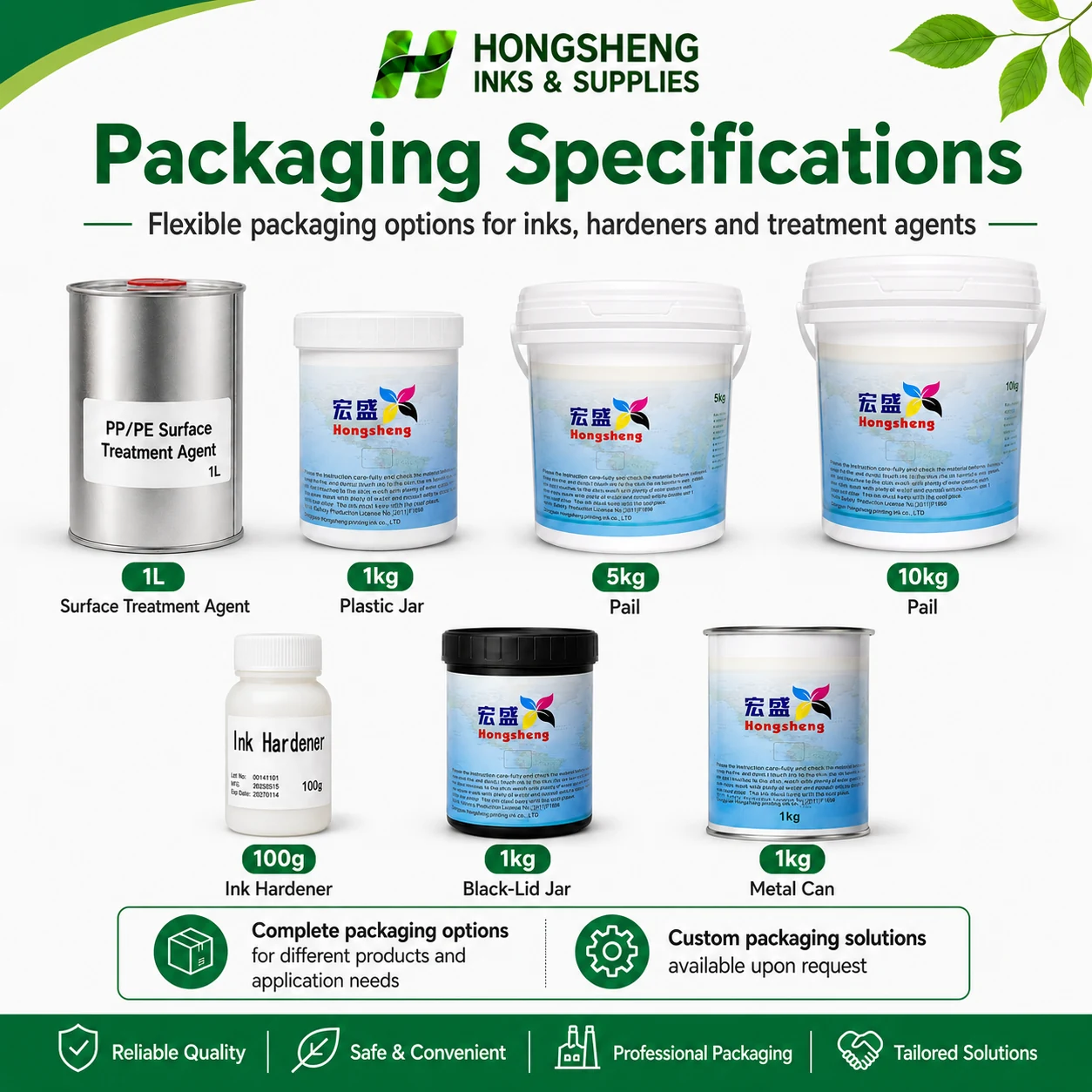
Packaging options

Confirm with HongshengH1014UV packagingPackage sizes are not specified in the supplied TDS.
Hongsheng general packaging specifications
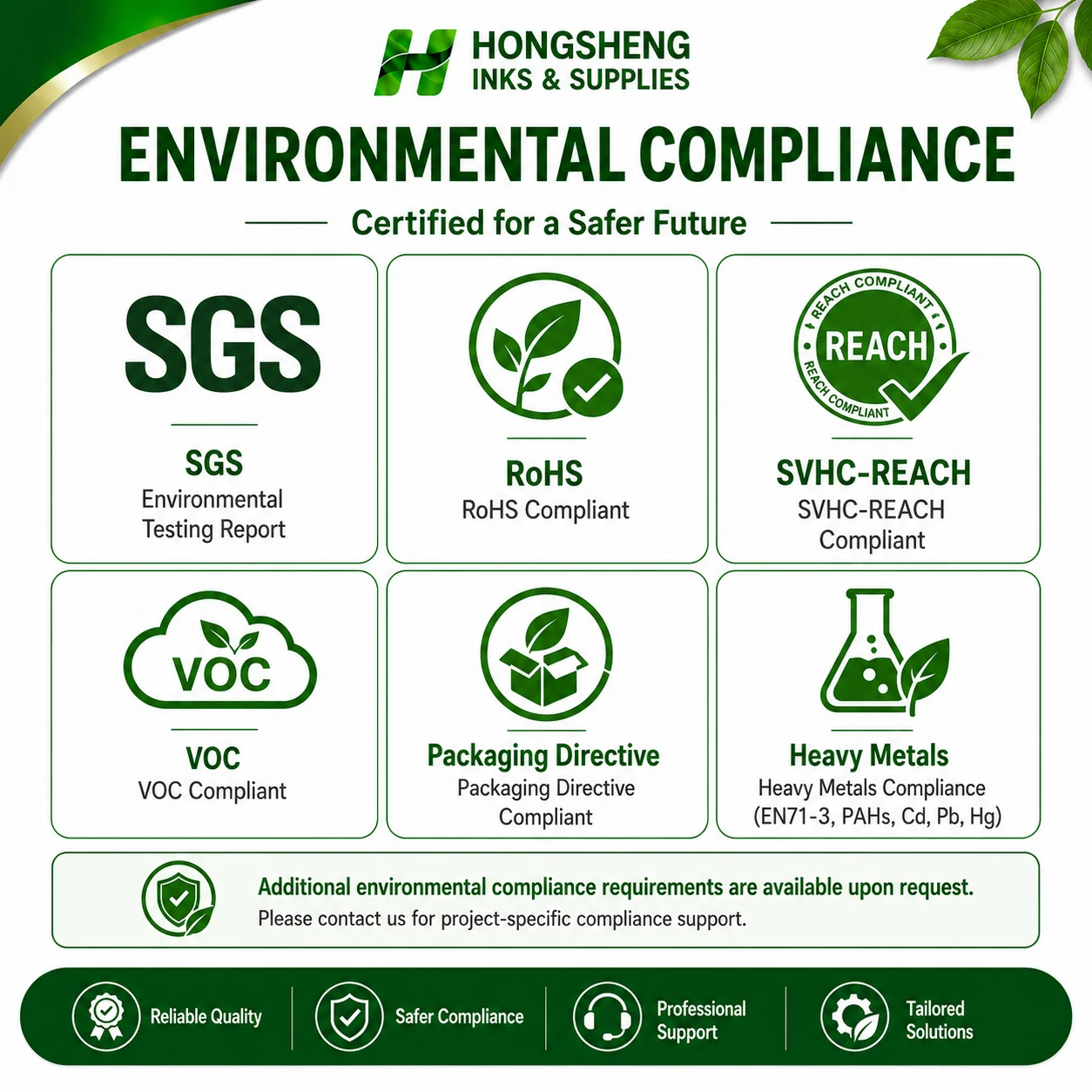
Hongsheng product compliance documentation scope

COMPLIANCE & DOCUMENTATION

Product documentation scope

Request the current H1014UV documentation for your selected color and destination market.

  • Confirm H1014UV compliance against the current SDS, test report, selected color and target-market requirements before release.
Request Compliance Documents

APPLICATION EVALUATION

Information Helpful for Application Evaluation

For an unresolved adhesion, curing or resistance problem, the following information helps Hongsheng evaluate the substrate, process, required tests and appropriate ink system.

  • Exact substrate and resin grade
  • Bottle or container type
  • Actual molded or finished sample
  • Surface-treatment method
  • Surface-tension reading, if available
  • Screen-printing setup
  • Automatic or semi-automatic line information
  • UV lamp and curing setup
  • Conveyor speed
  • Ink color
  • Current printing problem
  • Required adhesion test
  • Required alcohol, cosmetic-cream or other resistance test
  • Intended end-use environment

TECHNICAL & CUSTOMIZATION SUPPORT

Support around the substrate, color and printing process

Custom Color Matching

Match the required appearance using the confirmed substrate and reference.

Formula Adjustment

Review adhesion, drying and resistance requirements together.

Compatibility Testing

Evaluate the actual substrate, treatment and printing conditions.

Printing Troubleshooting

Review leveling, edge definition, adhesion and drying issues.

Discuss Your Application

WHY CHOOSE HONGSHENG

Focused support for industrial printing projects

Customized formulationSubstrate testing supportFlexible packaging supportConsistent product performance
Learn More About Hongsheng →