Flexible & Specialty Material Ink Series

H105

H105 Heat-Curing Silicone Ink

A silicone rubber printing ink for high-temperature vulcanized silicone products, requiring catalyst addition and heat curing for durable adhesion and resistance.

Catalyst-Cured AdhesionFlexible & Crack ResistantAbrasion ResistanceAlcohol Resistance
Printing Method
Screen Printing & Pad Printing
Recommended Substrates
Silicone-Rubber Keypads · Silicone Buttons · Molded Silicone Products · Compatible Silicone Components
Printing MethodScreen Printing & Pad Printing
Ink TypeHeat-curing silicone rubber ink
Component TypeCatalyst-cured system
Curing Method160–180°C for 8–10 minutes
Recommended SubstratesCompatible silicone-rubber products
Main ApplicationDurable silicone decoration

PRODUCT SUMMARY

H105 at a Glance

Substrate Focus
Compatible silicone rubber, including keypads, buttons and molded components
Printing Methods
Screen printing and pad printing
Curing System
Catalyst-assisted heat curing
Curing Reference
Actual measured 160–180°C for 8–10 minutes
Performance Focus
Adhesion, flexibility and documented alcohol and abrasion resistance
Validation
Actual-part testing is recommended before production

KEY PERFORMANCE

Performance built around the printed finish

01

Catalyst-Cured Adhesion

Excellent adhesion after catalyst curing and heat treatment.

02

Flexible & Crack Resistant

Maintains integrity on compatible silicone products.

03

Abrasion Resistance

No ink removal under the stated manual test.

04

Alcohol Resistance

No visible change under the stated rubbing test.

RECOMMENDED SUBSTRATES

Recommended Silicone Applications

Performance depends on substrate, surface treatment, printing process and drying or curing conditions. Substrate testing is required before production.

Silicone-Rubber KeypadsSilicone ButtonsMolded Silicone ProductsCompatible Silicone Components

SILICONE PRINTING

Why Is Silicone Difficult to Print?

Why is ink adhesion difficult on silicone rubber?
Check the exact silicone formulation, molded-part condition, contamination or mold-release residue, and ink compatibility. Catalyst preparation and the complete heat-curing process must also match the selected silicone ink.
Why does ordinary plastic ink peel off silicone?
Compatibility with a plastic does not establish compatibility with silicone rubber. Evaluate a system documented for the actual silicone compound and validate its catalyst and curing process on finished parts.
Why can an ink work on one silicone part but fail on another?
Silicone formulations, surface conditions and part geometries can differ. A successful test on one component does not qualify every silicone product.
Does every silicone rubber use the same printing ink?
No universal recommendation applies. Identify the actual compound, printing method, curing capability and required performance before selecting the ink.

INK SELECTION

What Ink Should Be Used for Silicone Rubber?

What ink is suitable for silicone-rubber printing?
Evaluate an ink documented for the actual silicone material. Hongsheng H105 is intended for compatible high-temperature vulcanized silicone-rubber products requiring catalyst addition and heat curing.
Can H105 be screen printed or pad printed?
The H105 TDS confirms both screen printing and pad printing on compatible silicone-rubber products. Validate transfer, artwork, catalyst preparation, flash-off and curing on the actual part.
Can ordinary rubber ink be used on silicone?
Do not infer silicone compatibility from conventional rubber applications. The ink must be evaluated specifically for the silicone compound and required cure.
What should be checked before choosing silicone ink?
Confirm the exact substrate, printing method, catalyst process, baking capability, adhesion, flexibility and required resistance. H105 is appropriate only where those conditions can be validated.

CATALYST PREPARATION

Why Does Silicone Ink Need Catalyst?

Why does H105 require catalyst?
H105 is a catalyst-assisted heat-curing system. Its documented adhesion and durability depend on catalyst addition followed by the specified heat-curing process.
How much catalyst should be added?
Prepare only the required amount of ink, add 3% catalyst before printing, and mix thoroughly and evenly. The TDS does not identify a catalyst trade name or specify an alternative addition rate.
Can catalyst be added to the original ink container?
No. The TDS instructs users to prepare a working quantity and not add catalyst directly to the original ink container.

WORKING TIME

Pot Life After Adding Catalyst

How long can prepared H105 ink be used?
Use the prepared ink within approximately four hours after mixing in the catalyst, as stated in the TDS.
How should a print run be organized around pot life?
Prepare quantities that can be used within the documented working time and record the mixing time. Keep the catalyst-mixed working batch separate from the original ink.
Can extra thinner extend the stated pot life?
The H105 source does not document a way to extend pot life. Do not treat viscosity adjustment as proof that a batch remains suitable beyond the stated working time.

THINNER SELECTION

Choosing the Correct Thinner for Silicone Ink

Which thinner is specified for H105?
Use only odorless kerosene. The documented addition is approximately 2–5%, adjusted to viscosity, artwork, printing method and operating conditions.
Can 783 thinner or cyclohexanone be used?
No. The H105 TDS explicitly excludes 783 thinner and cyclohexanone. Thinners recommended for other Hongsheng inks must not be substituted automatically.
What should be checked when adjusting printability?
Review the approved thinner, addition amount, viscosity, artwork and screen or pad transfer. Keep the catalyst mixing and curing procedure consistent during evaluation.

SOLVENT FLASH-OFF

Why Flash-Off Is Important Before Baking

How long should a printed part stand before oven curing?
Allow 5–10 minutes for solvent flash-off before oven curing. Confirm sufficient evaporation on the actual part and under the production conditions.
Why can bubbles appear after baking?
The TDS identifies inadequate flash-off as a possible cause of bubbles in the cured ink film. Check the delay before baking and whether the solvent has sufficiently evaporated.
Does flash-off replace heat curing?
No. Flash-off allows thinner to evaporate before the catalyst-assisted heat-curing stage; it does not establish a complete cure.

CURING PROCESS

Heat Curing Silicone Ink: Temperature & Time

What temperature and time does H105 require?
After flash-off, oven cure at an actual measured temperature of 160–180°C for 8–10 minutes. Verify the schedule on the actual silicone compound and part geometry before production.
Is the oven setting enough to confirm the cure?
The TDS specifies actual measured temperature. Confirm the effective curing conditions experienced by the printed parts rather than relying only on the oven setting.
Can H105 be treated as an air-drying ink?
No. The documented process requires catalyst addition and heat curing. A dry-looking surface after standing does not confirm that the ink has cured.

PEELING DIAGNOSIS

Why Silicone Ink Still Peels After Baking

What should be checked if a baked print peels?
Review the exact silicone, surface contamination or mold-release residue, catalyst addition and mixing, elapsed pot life, approved thinner, flash-off, actual curing temperature and time, and possible catalyst-poisoning contact.
Does putting the part in an oven prove complete curing?
No. Check the measured conditions and validated schedule for the actual compound and geometry. Baking alone does not establish correct catalyst preparation or compatibility.
How should a suspected adhesion problem be evaluated?
Complete the documented process on representative finished parts, then evaluate adhesion using the required test. Review the failed process conditions with Hongsheng before changing the formulation or cure.

CURING CONTAMINATION

Catalyst Poisoning in Silicone Ink

What does the H105 TDS say about catalyst poisoning?
Prevent the original ink from contacting reactive materials containing nitrogen, sulfur, phosphorus or other catalyst-poisoning substances, because they may interfere with curing.
What should be reviewed if curing is inconsistent?
Review materials that contact the ink and the handling process for possible contamination, alongside catalyst mixing, pot life and measured curing conditions.
Can extra catalyst or longer baking be assumed to fix contamination?
The TDS does not provide such a remedy. Identify the contact source and obtain technical evaluation instead of assuming an unverified adjustment will restore curing.

BONDING AND FLEXING

Adhesion vs. Flexibility on Silicone Parts

What is the difference between adhesion and flexibility?
Adhesion concerns the ink film remaining attached to silicone. Flexibility concerns its response when the printed part bends. Both should be evaluated after the required cure.
Does passing a tape test establish bending performance?
No. H105 documents adhesion and a separate bending test. Validate both against the actual part's required movement and acceptance criteria.
What flexibility result is documented?
No cracking or peeling was observed in the documented bending test. The TDS does not specify a bend angle, stretch percentage or cycle count.

SEPARATE DURABILITY CHECKS

Adhesion vs. Alcohol vs. Abrasion Resistance

Adhesion checks whether the ink remains bonded to silicone. Alcohol resistance checks the print's response to alcohol rubbing. Abrasion resistance checks mechanical wear. Passing one test does not establish the other two.

How should the three requirements be validated?
Complete catalyst-assisted heat curing, then test adhesion, alcohol resistance and abrasion separately on the actual finished part using the customer's acceptance criteria.
Does the TDS specify alcohol or abrasion rub counts?
No. It reports no visible change in an alcohol rubbing test and no ink removal in a manual rubbing test. It does not document a load or rub count for either result.

PROCESS AND SERVICE CONDITIONS

Curing Temperature vs. Heat Resistance

Are curing temperature and heat resistance the same specification?
No. The 160–180°C for 8–10 minutes condition is the production curing process. The separate heat-resistance reference reports no visible change at 150°C for one hour.
Does the curing temperature establish a continuous service rating?
No. Neither the curing schedule nor the one-hour reference establishes continuous service life at that temperature. Evaluate the actual end-use temperature and exposure requirement separately.

DOCUMENTED PERFORMANCE

Documented Test Reference

RequirementDocumented H105 Reference
Adhesion100/100 squares retained · 1 mm × 1 mm cross-cut; 3M tape peel after catalyst curing
FlexibilityNo cracking or peeling · Bending test
Abrasion resistanceNo ink removal · Manual rubbing test
Alcohol resistanceNo visible change · Alcohol rubbing test
Water resistanceNo visible change · Tap-water immersion at 20°C for 96 h
Heat resistanceNo visible change · 150°C for 1 h

These are H105 internal reference results, not guarantees for every silicone compound. Validate the actual substrate, catalyst preparation, printing, complete cure and customer-specific requirements before production.

DIAGNOSTIC PATH

Silicone Printing Troubleshooting

  1. 1
    Identify the silicone and finished part

    Confirm the actual compound, molded condition, geometry and required performance.

  2. 2
    Check surface and ink compatibility

    Review contamination, mold-release residue and results on representative silicone components.

  3. 3
    Prepare catalyst correctly

    Add 3% catalyst to a working quantity and mix thoroughly and evenly.

  4. 4
    Track the working time

    Use prepared ink within approximately four hours; keep it out of the original container.

  5. 5
    Use the specified thinner

    Use only odorless kerosene, approximately 2–5%, adjusted to the documented process factors.

  6. 6
    Confirm printing and flash-off

    Review screen or pad transfer and allow 5–10 minutes of sufficient solvent evaporation before baking.

  7. 7
    Review poisoning risks

    Prevent contact with the catalyst-poisoning substances identified in the TDS.

  8. 8
    Verify actual curing conditions

    Measure 160–180°C for 8–10 minutes and validate the schedule for the compound and part geometry.

  9. 9
    Test the cured print

    Evaluate adhesion, flexibility, alcohol, abrasion and other required resistance properties separately.

  10. 10
    Confirm the application with Hongsheng

    Use H105 only where the silicone, catalyst and heat-curing process meet the validated requirements.

APPLICATION BOUNDARIES

When H105 May Not Be the Right Ink

H105 is intended for compatible silicone-rubber products and is not a general rubber or plastic ink. Conventional rubber, TPU, TPE, EVA and other unconfirmed materials must not be assigned to H105 without source support and technical evaluation.

Applications that cannot accommodate the specified catalyst preparation, flash-off or heat-curing process need another evaluation. Unknown silicone compounds and requirements beyond the documented adhesion, flexibility or resistance references require actual-part testing; H105 does not guarantee freedom from peeling.

TECHNICAL INFORMATION

Technical Information

Key reference data for product selection and printing evaluation.

Product Type
Heat-curing silicone rubber printing ink
Printing Method
Screen Printing & Pad Printing
Recommended Substrates
Silicone-rubber keypads, buttons, molded silicone products and compatible silicone components
Component Type
Catalyst-cured system
Catalyst Addition
3% catalyst; mix thoroughly before printing
Pot Life
Use prepared ink within approximately 4 hours
Thinner
Odorless kerosene only; approximately 2–5%
Flash-Off
5–10 minutes before oven curing
Curing Conditions
Actual measured temperature of 160–180°C for 8–10 minutes
Adhesion
100/100 squares retained · 1 mm × 1 mm cross-cut; 3M tape peel after catalyst curing
View Additional Test Data
Flexibility
No cracking or peeling · Bending test
Abrasion Resistance
No ink removal · Manual rubbing test
Alcohol Resistance
No visible change · Alcohol rubbing test
Water Resistance
No visible change · Tap-water immersion at 20°C for 96 h
Heat Resistance
No visible change · 150°C for 1 h

Test results are for reference only. Actual performance depends on substrate, surface treatment, printing process and drying or curing conditions.

Technical notes
  • Use only odorless kerosene as thinner; do not use 783 thinner or cyclohexanone.
  • Do not add catalyst directly to the original ink container.
  • Allow sufficient solvent flash-off before oven curing to avoid bubbles.
  • Prevent contact with nitrogen-, sulfur- or phosphorus-containing catalyst-poisoning substances.
  • Store unopened containers at 0–10°C; shelf life is 6 months from manufacture.

PACKAGING OPTIONS

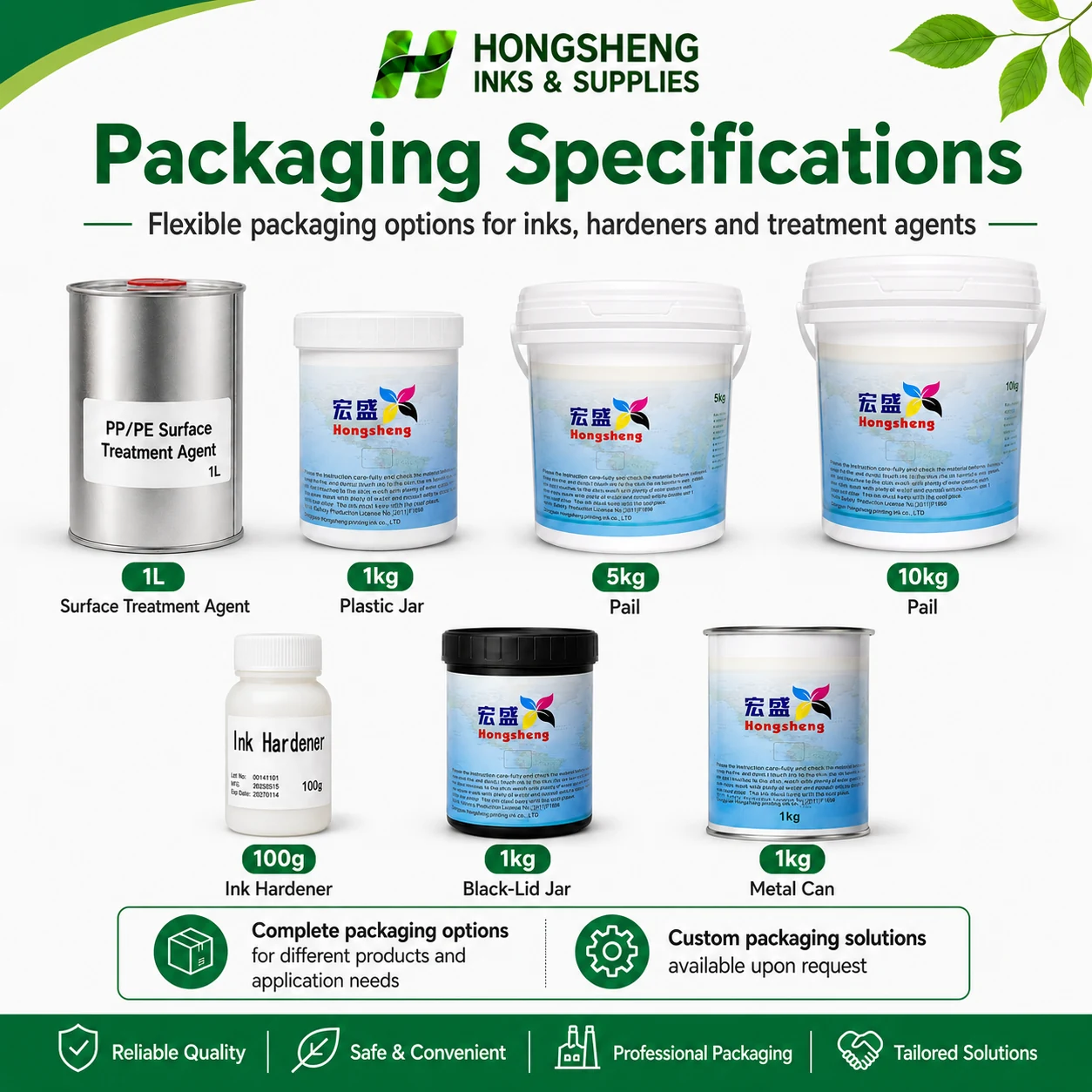
Packaging options

1 kgStandard package
5 kgPailUpon request
10 kgPailUpon request
CustomCustom packagingUpon request
Hongsheng general packaging specifications
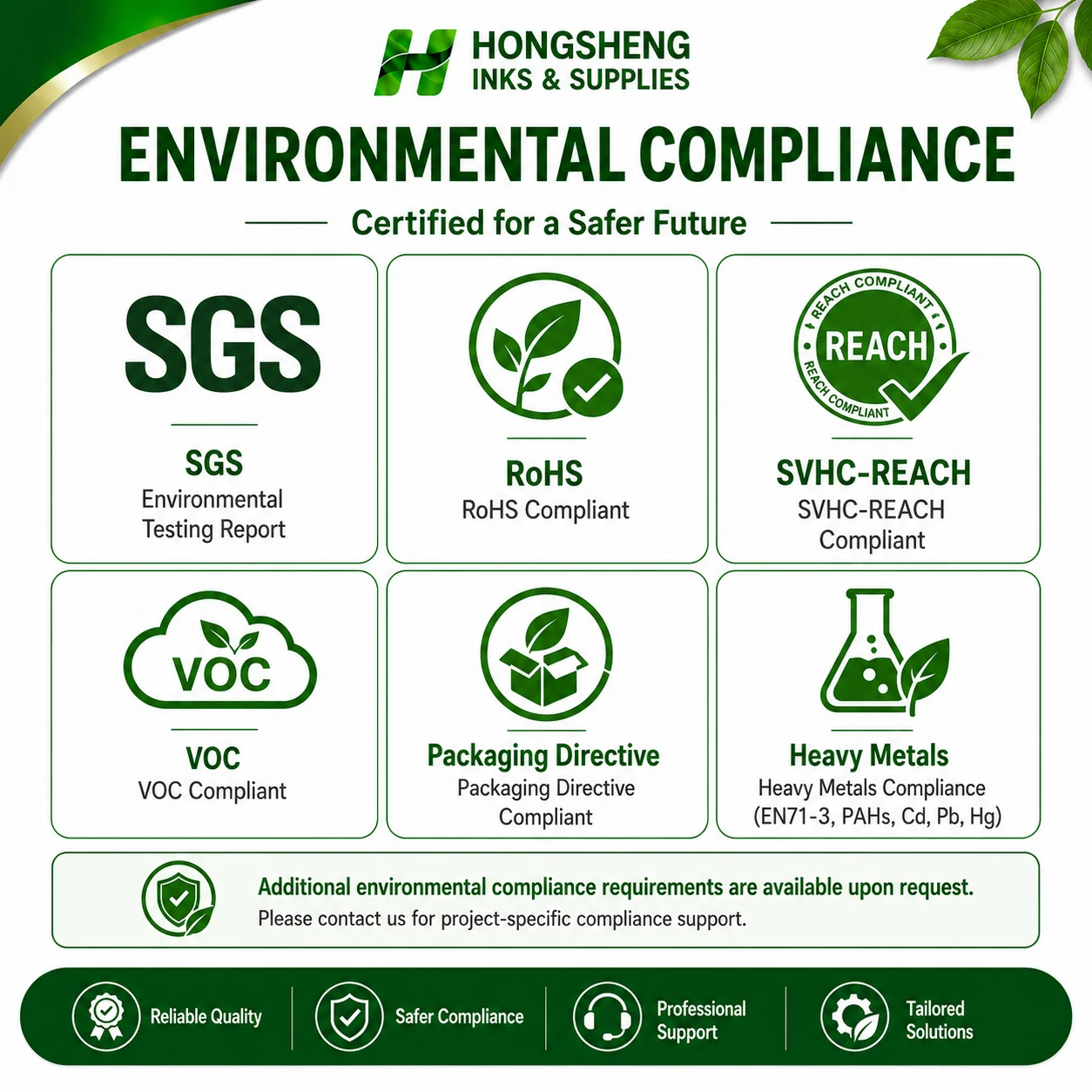
Hongsheng product compliance documentation scope

COMPLIANCE & DOCUMENTATION

Product documentation scope

The available documentation scope for this product includes the items shown below. Please identify the required color and destination market when requesting the applicable report.

  • Product- and color-specific compliance documentation is available upon request.
  • Confirm the required regulation, test method, color and target market before ordering.
Request Compliance Documents

APPLICATION EVALUATION

Information Helpful for Application Evaluation

Provide the available details so Hongsheng can review silicone compatibility, catalyst preparation, printing, curing and the required finished-part performance before recommending H105.

  • Exact silicone compound and grade, if known
  • Actual molded sample and part geometry
  • Surface condition and mold-release residue
  • Screen printing or pad printing
  • Artwork and ink color
  • Catalyst identity, addition and mixing method
  • Time elapsed since catalyst mixing
  • Thinner identity and addition
  • Flash-off time and conditions
  • Materials contacting the ink
  • Oven setup and actual measured curing temperature
  • Curing time
  • Current peeling, bubbling or incomplete-cure problem
  • Adhesion and flexibility requirements
  • Alcohol, abrasion, water and heat-test requirements
  • End-use conditions and customer acceptance criteria

TECHNICAL & CUSTOMIZATION SUPPORT

Support around the substrate, color and printing process

Custom Color Matching

Match the required appearance using the confirmed substrate and reference.

Formula Adjustment

Review adhesion, drying and resistance requirements together.

Compatibility Testing

Evaluate the actual substrate, treatment and printing conditions.

Printing Troubleshooting

Review leveling, edge definition, adhesion and drying issues.

Discuss Your Application

WHY CHOOSE HONGSHENG

Focused support for industrial printing projects

Customized formulationSubstrate testing supportFlexible packaging supportConsistent product performance
Learn More About Hongsheng →