Plastic Substrate Ink Series

H638

H638 High Opacity Plastic Ink

A glossy, single-component, low-odor aromatic solvent-based ink developed for high-opacity printing with strong color intensity on black or dark-colored plastics.

High OpacityVivid Color StrengthSmooth PrintingReliable Adhesion
Printing Method
Screen Printing & Pad Printing
Recommended Substrates
Rigid PVC · Flexible PVC · PMMA · ABS · PC · PS
Printing MethodScreen & Pad Printing
Ink TypeHigh-opacity solvent-based plastic ink
Component TypeSingle-component
Drying MethodAir drying or low-temperature oven drying
Recommended SubstratesPVC · PMMA · ABS · PC · PS
Main ApplicationBright graphics on dark plastics

PRODUCT SUMMARY

H638 at a Glance

Application Focus
High-opacity plastic printing where substrate-color interference matters
Printing Methods
Screen printing and pad printing
Confirmed Substrates
Rigid and flexible PVC, PMMA, ABS, PC and PS
Performance Focus
Hiding power, color strength, printability and adhesion
Screen Mesh
80–120T for confirmed screen-printing applications
Validation
Actual substrate-color and ink-color testing is recommended

KEY PERFORMANCE

Performance built around the printed finish

01

High Opacity

Excellent coverage on black and dark-colored plastics.

02

Vivid Color Strength

Strong color intensity and vivid print appearance.

03

Smooth Printing

Smooth printing performance with good leveling.

04

Reliable Adhesion

Reliable adhesion on common compatible plastics.

RECOMMENDED SUBSTRATES

Confirmed compatible materials

Performance depends on substrate, surface treatment, printing process and drying or curing conditions. Substrate testing is required before production.

Rigid PVCFlexible PVCPMMAABSPCPS

HIGH-OPACITY PLASTIC PRINTING

High-Opacity Printing on Dark & Colored Plastic

What ink should be evaluated for printing white on black plastic?
Use a plastic ink documented for high opacity and confirm it on the exact black substrate. Final white appearance depends on substrate compatibility, ink color, mesh, ink deposit, film thickness, drying and adhesion.
What plastic ink provides better hiding power on dark substrates?
Evaluate a high-opacity system within its confirmed substrate range. H638 is designed for high-opacity screen and pad printing on compatible plastics, subject to actual-color and finished-part testing.
Why does the substrate color show through printed ink?
The background color, ink color, deposited film and printing setup all affect perceived coverage. Diagnose the actual part rather than judging opacity on a different substrate.
What should be checked when printing light colors on dark plastic?
Confirm the exact resin, substrate color, desired ink color, artwork, printing method, 80–120T mesh range, ink transfer, drying, adhesion and final visual standard.
When should a high-opacity ink be considered?
Consider it when dark or colored substrate interference makes hiding power and final color appearance central requirements. It is not necessary for every plastic application and does not guarantee a universal coverage result.

COVERAGE DIAGNOSIS

Why Plastic Prints Look Transparent or Lack Coverage

Why does white ink look gray or transparent on black plastic?
Possible factors include the dark background, ink color, mesh, transferred ink deposit, film thickness and the required visual standard. No single cause applies to every part.
Why does the plastic color show through the printed image?
Final color is influenced by the substrate background, selected ink system, deposited film, printing conditions and actual surface. Evaluate the complete combination on the production part.
Why can the same ink cover one plastic color well but look weak on another?
Different background colors change the perceived printed color and hiding effect. Compare candidate colors on each actual substrate color without assuming identical results.
Why does increasing ink thickness not always solve opacity problems?
Excessive deposit can reduce print definition, affect edge quality, extend drying and create adhesion or process-consistency problems. Balance coverage with the full printing and drying result.

LIGHT COLORS ON DARK SUBSTRATES

White & Light-Color Printing on Dark Plastic

How can bright white be evaluated on black plastic?
Print the selected white on the actual black part using the intended mesh, ink deposit and drying process, then assess coverage, color appearance, definition and adhesion against the customer standard.
Why can yellow, red or other light colors look dull on dark plastic?
The dark background can influence perceived color when the deposited film does not fully mask it. Ink color, artwork, mesh, deposit and process conditions should be evaluated together.
Do light colors need higher-opacity ink on dark substrates?
They may require a high-opacity system when background interference is unacceptable, but the decision depends on the color pair, artwork and visual acceptance standard.
Is an underbase always required?
No universal rule applies. Determine whether an underbase is appropriate through actual print evaluation, considering color appearance, film build, detail, drying and production workflow.
Are multiple passes always required?
No. The suitable print strategy depends on the substrate color, ink color, required appearance, artwork, mesh, ink transfer and validated production result.

INK DEPOSIT CONTROL

Mesh, Ink Film & Opacity: What Buyers Should Check

Does mesh count affect ink opacity?
Mesh and the complete printing setup influence ink transfer and deposited film, which can affect hiding power. H638 documents a recommended screen-mesh range of 80–120T.
Why can a finer mesh reduce ink deposit?
Depending on the complete screen setup, a finer mesh may transfer a different ink deposit. Confirm the actual film and visual result instead of relying on mesh count alone.
Does a thicker ink film always improve hiding power?
Not automatically. More deposit may change coverage, but it can also affect detail, edge definition, drying, adhesion and production consistency.
How should mesh be selected for high-opacity printing?
Work within the documented H638 range and select the final mesh using artwork, required deposit, detail, substrate, drying and final visual evaluation.
Why should print detail and opacity be balanced?
Opacity depends partly on the deposited film, while fine lines and edges require controlled transfer. The production setup must deliver both the visual target and stable drying and adhesion.

ADHESION & DRYING

Common Adhesion & Drying Problems

Why can a high-opacity print still peel off plastic?
High opacity does not prove adhesion. Check the exact resin, surface condition, contamination or mold-release residue, ink compatibility, deposited film, complete drying and required adhesion test.
Why can a heavier ink film take longer to dry?
A larger deposit can require more time for the complete film to reach the intended drying condition. Validate film thickness, ventilation, temperature and the production drying schedule.
Why is the print still soft after printing?
Review thinner selection, film thickness, substrate and ambient temperature, ventilation and elapsed drying time. H638 drying varies with the substrate, film, temperature and ventilation.
Why should adhesion be checked only after complete drying?
Testing a partially dried film may not represent final performance. H638's reference full-drying condition is 24 hours of air drying or 80°C oven curing for 30 minutes.
Why can increasing ink deposit affect production stability?
Deposit changes can influence transfer, definition, drying, adhesion and repeatability. Confirm all required properties before fixing the production setup.

PERFORMANCE VERIFICATION

Meeting Opacity, Adhesion & Appearance Requirements

How should opacity be evaluated on dark plastic?
Use the customer's actual substrate color, selected ink color, artwork and production setup, then assess the dried print under the agreed visual conditions.
What should be checked when strong hiding power is required?
Confirm substrate compatibility and color, ink color, mesh, ink transfer, film thickness, drying, adhesion, print detail and the final acceptance standard.
How should adhesion be verified?
Allow complete drying, then use the customer-required cross-cut, tape or other method on the actual finished part and compare it with the documented H638 reference.
What should be confirmed before mass production?
Validate substrate and background color, selected ink color, artwork, mesh and deposit, complete drying, adhesion, final appearance and production consistency on representative parts.
How should final color appearance be evaluated?
Judge the dried print on the actual substrate color using the agreed lighting, viewing and customer acceptance conditions. Do not infer appearance from a different background.

DOCUMENTED PERFORMANCE

Documented Test Reference

RequirementDocumented H638 Reference
Screen mesh80–120T · Final selection depends on ink deposit, artwork and printing conditions
Ink fineness≤ 12 μm · Grind gauge
Dry-film gloss≥ 65 GU · 60° gloss meter
Surface dryingHot air at 40–60°C · Recommended reference: 50°C
Full dryingAir dry for 24 hours, or oven cure at 80°C for 30 minutes
Alcohol resistanceNo visible change · 500 g load; 500 double rubs with an alcohol-saturated cotton pad
Adhesion100/100 squares retained · 1 mm × 1 mm, 100-grid cross-cut; 3M tape peel
Acid resistanceNo visible change · 5% HCl immersion for 24 h
Alkali resistanceNo visible change · 5% NaOH immersion for 24 h
Salt-water resistanceNo visible change · 5% NaCl immersion for 24 h
Water resistanceNo visible change · Tap-water immersion at 20°C for 96 h
Documented high-opacity referenceNo substrate exposure · 500 g load; 500 double rubs with an abrasive eraser
Heat resistanceNo visible change · 80°C for 12 h

Reference data reflects documented H638 test conditions. The TDS does not specify an opacity percentage, contrast ratio or guaranteed print-pass count. Actual results depend on substrate color, ink color, deposit, drying, printing process and customer requirements.

OPACITY-FOCUSED SELECTION

How to Choose Ink When High Opacity Matters

When should buyers consider a high-opacity plastic ink?
Consider it for confirmed compatible plastics where dark substrate color, white or light-color printing, background interference, hiding power or visual uniformity are important. Not every plastic job requires this focus.
What should buyers compare when selecting high-opacity plastic ink?
Compare substrate compatibility and color, ink color, hiding requirement, mesh and deposit, adhesion, drying, print detail, final appearance, production consistency and technical support.
Is the highest-opacity ink always the best choice?
Not necessarily. Selection should balance opacity, detail, printability, film thickness, drying, adhesion, production speed and the actual visual requirement.

DIAGNOSTIC PATH

High-Opacity Plastic Printing Troubleshooting

  1. 1
    Identify the exact resin

    Confirm rigid or flexible PVC, PMMA, ABS, PC or PS within the documented H638 scope.

  2. 2
    Identify the substrate color

    Record the actual background color and any surface variation.

  3. 3
    Define the required ink color

    Confirm the target color, artwork and final visual acceptance standard.

  4. 4
    Confirm the printing method

    Verify the screen-printing or pad-printing setup supported by H638.

  5. 5
    Check mesh and ink transfer

    For screen printing, work within the documented 80–120T range and inspect the actual transfer.

  6. 6
    Evaluate ink-film deposit

    Balance the deposited film with opacity, detail, edge quality and production consistency.

  7. 7
    Confirm complete drying

    Use the validated air-drying or oven-curing schedule before final evaluation.

  8. 8
    Verify adhesion

    Run the required adhesion test on the actual substrate after complete drying.

  9. 9
    Evaluate opacity and final color

    Judge the dried print on the customer's actual substrate color under the agreed visual conditions.

  10. 10
    Select the appropriate Hongsheng system

    Use H638 only where the substrate, process and verified opacity scope fit; otherwise request evaluation of another plastic ink system or formulation.

APPLICATION BOUNDARIES

When H638 May Not Be the Right Ink

H638 is not a universal ink for every plastic. Unconfirmed resins, grades, surface treatments and low-surface-energy materials require actual-part testing, and unknown dark or colored substrates must be evaluated using the intended ink color and production setup.

Where the primary requirement is alcohol and abrasion durability, ultra-high gloss, or only standard plastic printing, another Hongsheng system may be more appropriate. Extreme opacity expectations and applications outside H638's confirmed substrate, printing, drying or appearance scope require technical evaluation.

TECHNICAL INFORMATION

Technical Information

Key reference data for product selection and printing evaluation.

Product Type
Glossy, low-odor aromatic high-opacity plastic ink
Printing Method
Screen printing and pad printing
Recommended Substrates
Rigid and flexible PVC, PMMA, ABS, PC and PS
Component Type
Single-component
Surface Drying
Hot air: 40–60°C (Recommended: 50°C)
Full Drying
Air dry for 24 hours, or oven cure at 80°C for 30 minutes
Screen Mesh
80–120T
Dry-Film Gloss
≥ 65 GU · 60° gloss meter
Adhesion
100/100 squares retained · 1 mm cross-cut; 3M tape peel
Alcohol Resistance
No visible change · 500 g load; 500 double rubs
View Additional Test Data
Ink Fineness
≤ 12 μm · Grind gauge
Acid Resistance
No visible change · 5% HCl immersion for 24 h
Alkali Resistance
No visible change · 5% NaOH immersion for 24 h
Salt-Water Resistance
No visible change · 5% NaCl immersion for 24 h
Water Resistance
No visible change · Tap-water immersion at 20°C for 96 h
Heat Resistance
No visible change · 80°C for 12 h
High Opacity
No substrate exposure · TDS condition: 500 g load; 500 double rubs with an abrasive eraser

Test results are for reference only. Actual performance depends on substrate, surface treatment, printing process and drying conditions.

Technical notes
  • Remove dust, oil, mold-release residue and other contaminants before printing.
  • Conduct a production trial before mass printing.
  • Drying and performance vary with substrate, surface treatment, film thickness, temperature and ventilation.
  • Shelf life: 12 months from manufacture in unopened original packaging; re-test expired material.

STANDARD COLORS & SPECIAL EFFECTS

Catalog Color Range

Standard, metallic, fluorescent and transparent colors shown in the catalog are available as reference options. Final appearance must be confirmed on the actual substrate.

PACKAGING OPTIONS
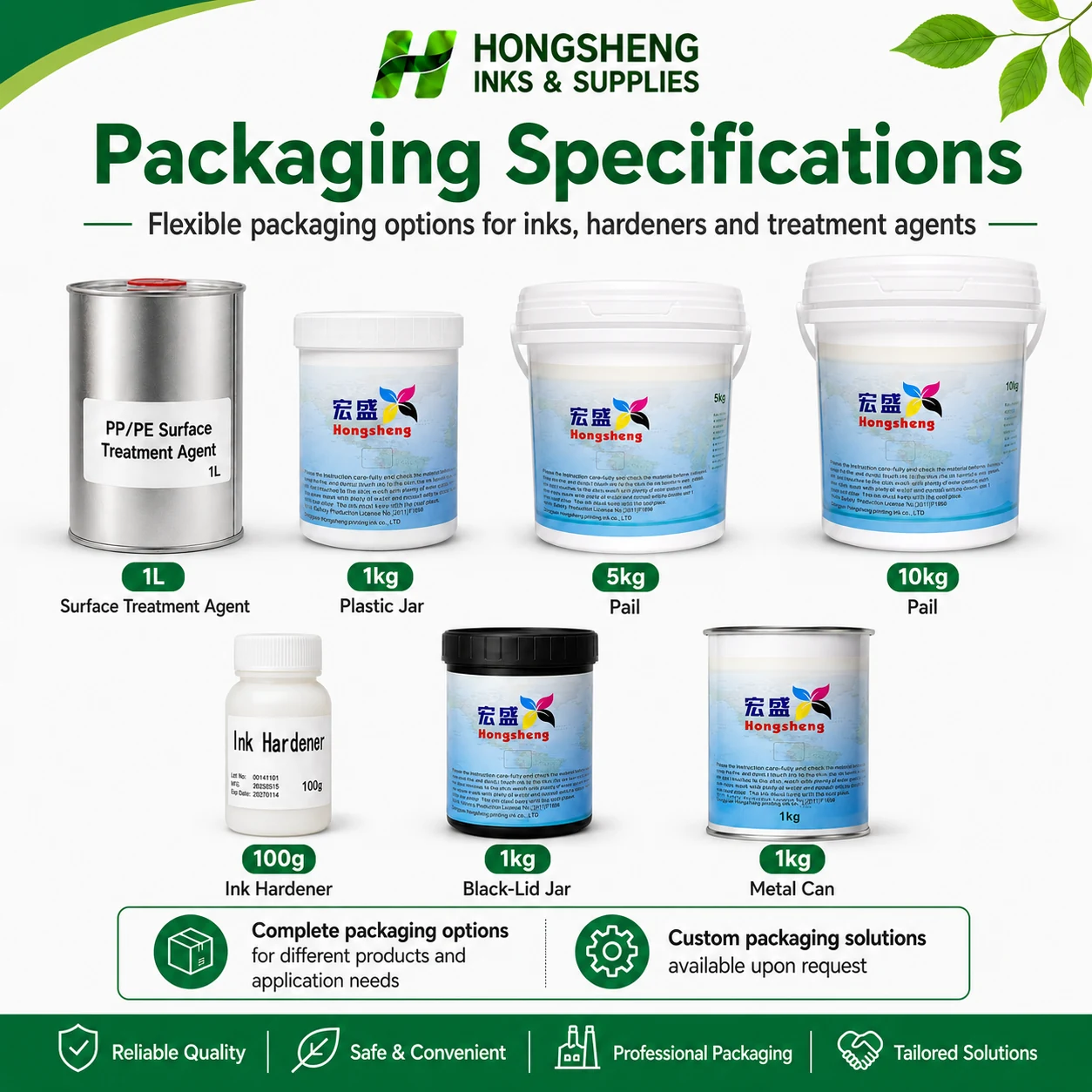
Packaging options

1 kgPlastic jarStandard package
5 kgPailGeneral packaging option
10 kgPailGeneral packaging option
CustomCustom packagingAvailability upon request
Hongsheng general packaging specifications
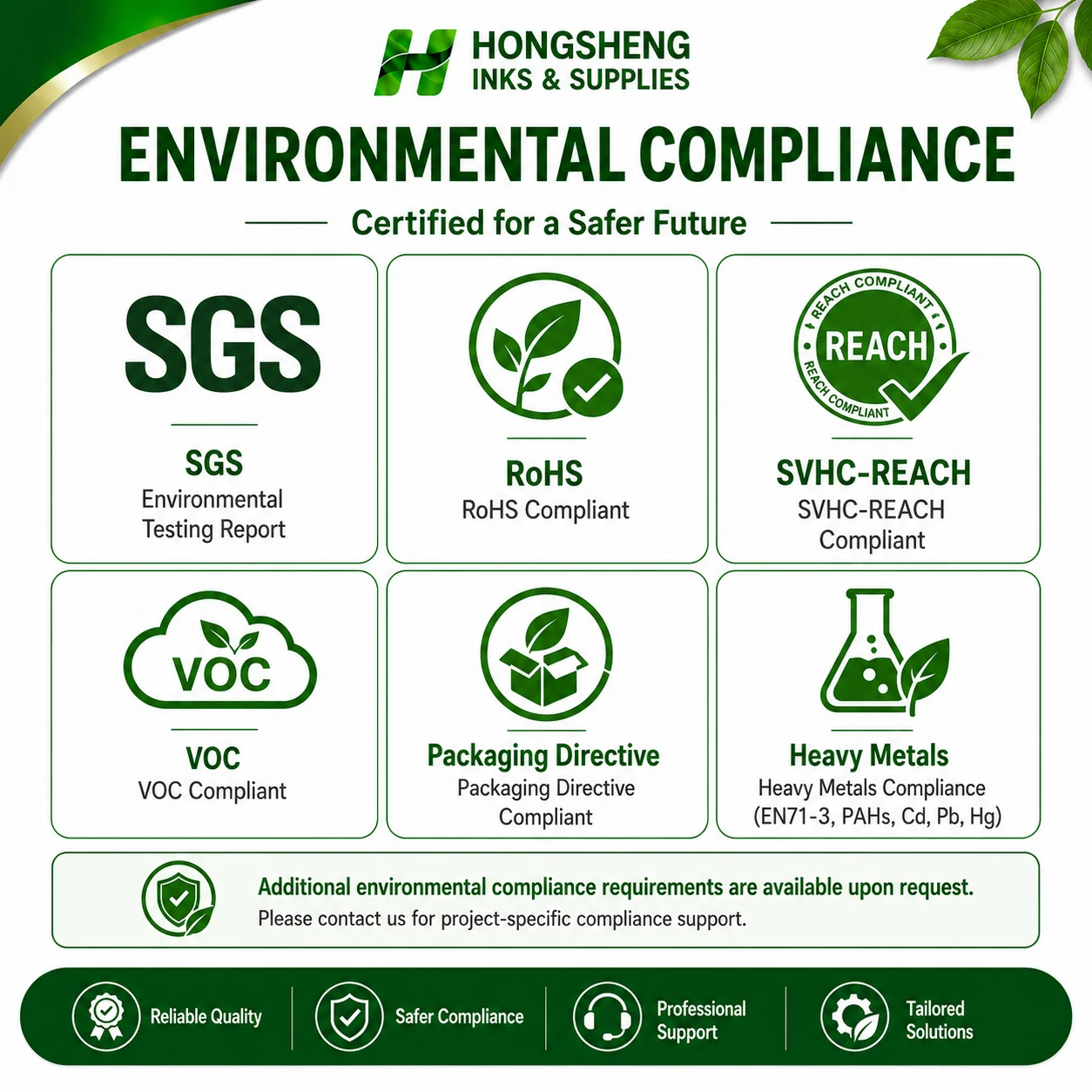
Hongsheng product compliance documentation scope

COMPLIANCE & DOCUMENTATION

Product documentation scope

The available documentation scope for this product includes the items shown below. Please identify the required color and destination market when requesting the applicable report.

  • Product- and color-specific compliance documentation is available upon request.
  • Confirm the destination market and required test scope before ordering.
Request Compliance Documents

APPLICATION EVALUATION

Information Helpful for Application Evaluation

Provide the available details below so Hongsheng can evaluate the actual substrate color, ink color, print deposit, drying, adhesion and visual requirement before recommending H638 or another suitable plastic ink system.

  • Exact plastic or resin
  • Material grade, if known
  • Actual finished sample
  • Substrate color
  • Screen printing or pad printing
  • Mesh specification, if relevant
  • Desired ink color
  • Desired final appearance
  • Required opacity or hiding effect
  • Artwork and printed area
  • Current print-pass setup
  • Current coverage problem
  • Drying setup
  • Adhesion requirement
  • Current ink system, if relevant
  • End-use environment
  • Customer visual acceptance standard

TECHNICAL & CUSTOMIZATION SUPPORT

Support around the substrate, color and printing process

Custom Color Matching

Match the required appearance using the confirmed substrate and reference.

Formula Adjustment

Review adhesion, drying and resistance requirements together.

Compatibility Testing

Evaluate the actual substrate, treatment and printing conditions.

Printing Troubleshooting

Review leveling, edge definition, adhesion and drying issues.

Discuss Your Application

WHY CHOOSE HONGSHENG

Focused support for industrial printing projects

Customized formulationSubstrate testing supportFlexible packaging supportConsistent product performance
Learn More About Hongsheng →