Non-Aggressive Solvent System
Developed for solvent-sensitive plastic substrates.
Plastic Substrate Ink Series
A single-component, room-temperature air-drying ink developed for solvent-sensitive plastic substrates, especially PS and PC. It helps reduce whitening, cracking, crazing and haze caused by aggressive solvent attack.
PRODUCT SUMMARY
KEY PERFORMANCE
Developed for solvent-sensitive plastic substrates.
Helps reduce whitening, cracking, crazing and haze.
Provides good leveling with rich color appearance.
Reliable adhesion subject to the substrate and application conditions.
RECOMMENDED SUBSTRATES
Performance depends on substrate, surface treatment, printing process and drying or curing conditions. Substrate testing is required before production.
SOLVENT-SENSITIVE PLASTICS
SUBSTRATE-DAMAGE DIAGNOSIS
COMPATIBILITY AND BONDING
STRESS-CRACK RISK CONTROL
PROCESS CONTROL
PERFORMANCE VERIFICATION
DOCUMENTED PERFORMANCE
| Requirement | Documented H646 Reference |
|---|---|
| Plastic stress-cracking response | No cracking or whitening observed · Printed on a stress-sensitive PC substrate |
| Substrate compatibility | No substrate damage or deformation · Visual inspection after printing |
| Adhesion | Substrate dependent · 1 mm × 1 mm cross-cut; 3M tape peel |
| Water resistance | No visible change · Tap-water immersion at 20°C for 96 h |
| Heat resistance | No visible change · 80°C for 12 h |
| Dry-film gloss | ≥ 65 GU · 60° gloss meter |
| Screen mesh | 100–200T · Final selection depends on ink deposit, artwork and printing conditions |
Reference data reflects documented H646 test conditions. Actual performance depends on substrate grade, molded-in stress, surface condition, ink-film thickness, printing process and drying conditions.
PRODUCT SELECTION
DIAGNOSTIC PATH
Confirm PC, PS, PVC, ABS or PMMA within H646's documented scope.
Record the material grade, additives, geometry, wall thickness and actual production part.
Consider molding history, internal stress and any mechanical load on the part.
Distinguish whitening, crazing, cracking, haze, deformation and adhesion failure.
Record the existing screen or pad printing conditions and recommended H646 thinner system.
Review film thickness, number of passes and, for screen printing, the 100–200T mesh range.
Confirm temperature, ventilation and enough time for complete drying before testing.
Check the printed part for visible damage after the intended drying and conditioning.
Run the required adhesion test separately on the fully dried production part.
Compare the complete result with the customer's final appearance and performance standard.
Use H646 only when its documented substrate and performance scope fit; otherwise request evaluation of another Hongsheng ink system or formulation.
APPLICATION BOUNDARIES
H646 is not a universal ink for every plastic. If the substrate is not solvent-sensitive, its lower-aggression focus may not be necessary. Unconfirmed resins and low-surface-energy materials such as PP or PE must not be mapped to H646 without technical evaluation and actual-part testing.
A primary requirement for enhanced alcohol and abrasion durability, high opacity, or ultra-high gloss may call for another Hongsheng plastic ink system. Severe molded-in stress, unusual solvent sensitivity, or any application outside H646's confirmed substrate, process or performance scope requires evaluation before a recommendation.
TECHNICAL INFORMATION
Key reference data for product selection and printing evaluation.
Test results are for reference only. Actual performance depends on substrate, surface treatment, printing process and drying conditions.
Technical notesSTANDARD COLORS & SPECIAL EFFECTS
Standard, metallic, fluorescent and transparent colors shown in the catalog are available as reference options. Final appearance must be confirmed on the actual substrate.
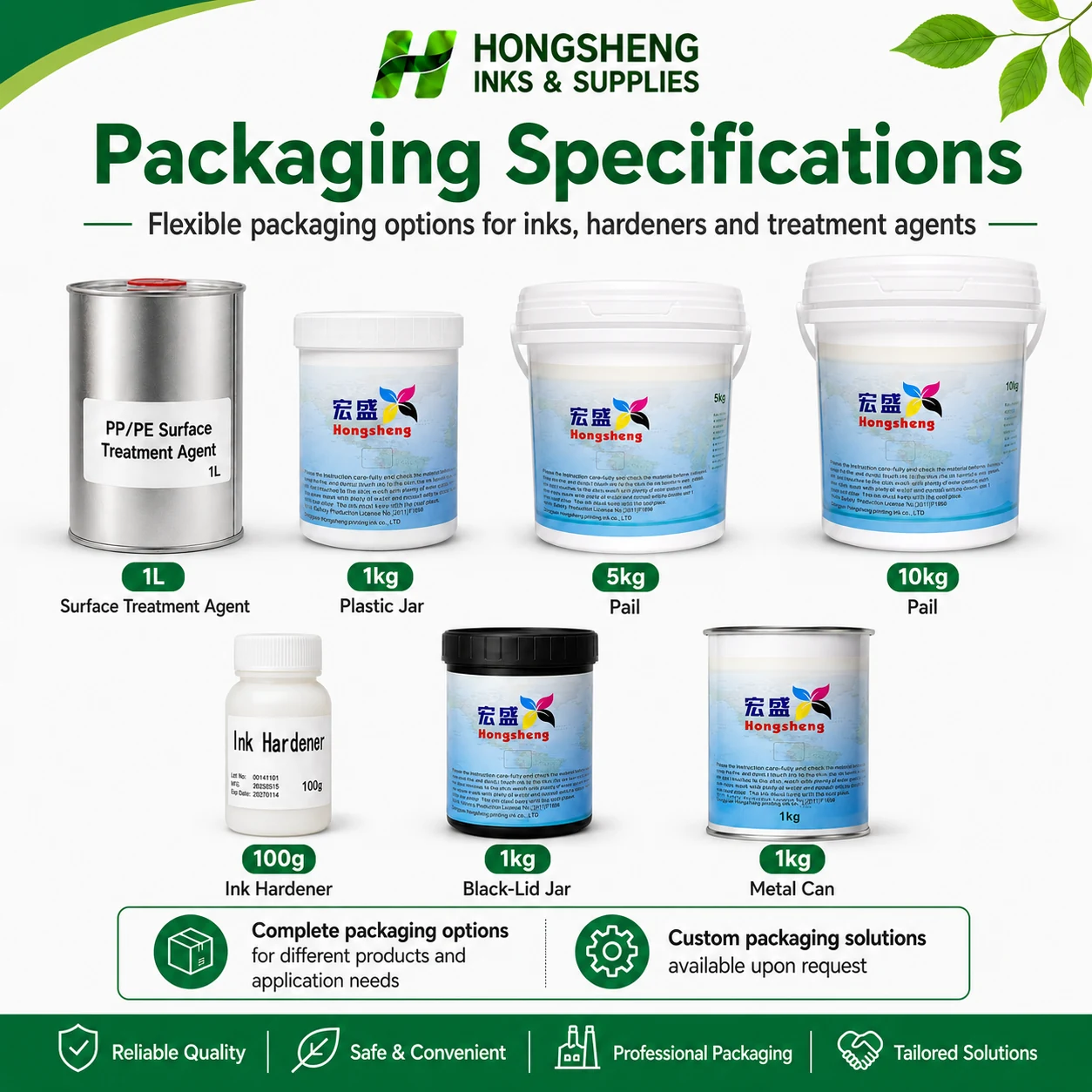
PACKAGING OPTIONS
COMPLIANCE & DOCUMENTATION
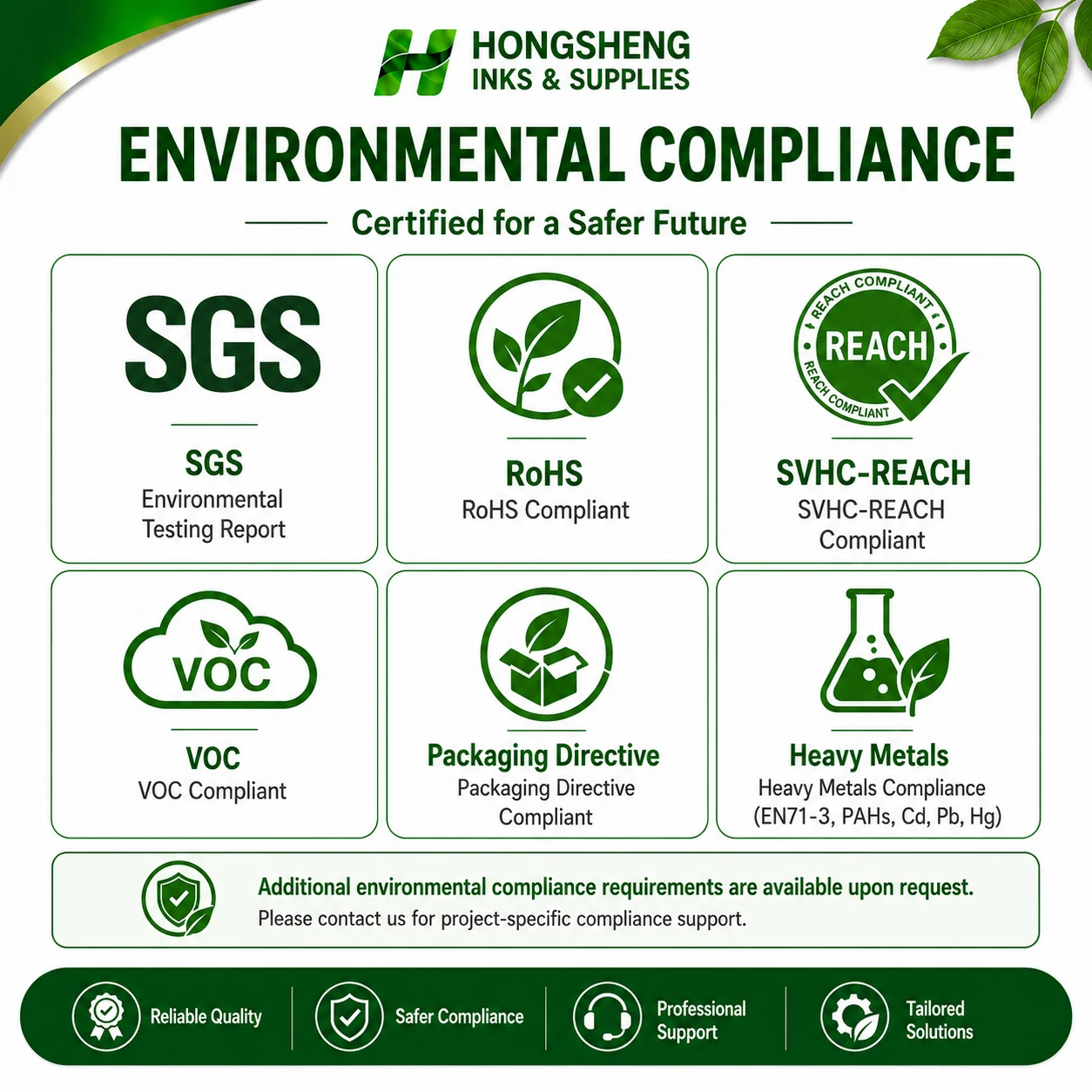
The available documentation scope for this product includes the items shown below. Please identify the required color and destination market when requesting the applicable report.
APPLICATION EVALUATION
Provide the available details below so Hongsheng can evaluate the failure mode, substrate integrity, drying, adhesion and appearance before recommending H646 or another suitable plastic ink system. Results must be confirmed on the actual production part.
TECHNICAL & CUSTOMIZATION SUPPORT
Match the required appearance using the confirmed substrate and reference.
Review adhesion, drying and resistance requirements together.
Evaluate the actual substrate, treatment and printing conditions.
Review leveling, edge definition, adhesion and drying issues.
WHY CHOOSE HONGSHENG