Plastic Substrate Ink Series

H698

H698 Special Abrasion Resistant Universal Ink

A glossy, single-component, low-odor solvent-based screen printing ink for exceptionally strong adhesion, abrasion resistance and alcohol resistance across selected substrates.

Very Strong AdhesionHigh Abrasion ResistanceHigh Alcohol ResistanceBroad Compatibility
Printing Method
Screen Printing & Pad Printing
Recommended Substrates
Rigid PVC · Flexible PVC · PMMA · ABS · PC · PS · PET · Metal · Coated Surfaces
Printing MethodScreen Printing & Pad Printing
Ink TypeUniversal low-odor solvent-based ink
Component TypeSingle-component
Drying MethodAir drying or low-temperature oven drying
Recommended SubstratesSelected plastics · PET · Metal · Coatings
Main ApplicationFrequently handled industrial parts

PRODUCT SUMMARY

H698 at a Glance

Application Focus
Broad compatibility across confirmed industrial substrates
Printing Methods
Screen printing and pad printing
Confirmed Substrates
Selected rigid and flexible PVC, PMMA, ABS, PC, PS, PET, metal and compatible coated surfaces
Ink System
Single-component, low-odor solvent-based ink
Performance Focus
Strong adhesion with documented alcohol and abrasion resistance
Validation
Every actual substrate, finish and coating requires separate testing

KEY PERFORMANCE

Performance built around the printed finish

01

Very Strong Adhesion

Strong adhesion on compatible selected substrates.

02

High Abrasion Resistance

Designed for frequent handling and demanding use.

03

High Alcohol Resistance

Tested under the stated TDS alcohol-rub condition.

04

Broad Compatibility

Selected plastics, PET, metals and compatible coated surfaces.

RECOMMENDED SUBSTRATES

Confirmed compatible materials

Performance depends on substrate, surface treatment, printing process and drying or curing conditions. Substrate testing is required before production.

Rigid PVCFlexible PVCPMMAABSPCPSPETMetalCoated Surfaces

MULTI-SUBSTRATE INDUSTRIAL PRINTING

Printing Across Multiple Industrial Substrates

What ink can be evaluated across plastic, PET and metal parts?
Use an ink whose documented range includes every actual material. H698 can be evaluated across selected compatible plastics, PET, metal and compatible coated surfaces, with each substrate tested independently.
Is there one screen or pad ink system for several compatible substrates?
A broad-compatibility system may support several confirmed materials, but printing conditions and performance must be validated on each production part. One successful result cannot be transferred automatically to another substrate.
What ink should be considered when one assembly contains different materials?
List every resin, PET grade, metal finish and coating, then compare drying, adhesion, alcohol resistance, abrasion resistance and customer requirements for each material.
What should be checked before using one ink across multiple substrates?
Confirm exact substrates, finish or coating, treatment where applicable, cleanliness, screen or pad process, drying, adhesion, alcohol and abrasion requirements and end-use conditions.
Can the same ink perform equally on plastic, PET and coated metal?
Do not assume identical performance. Surface condition and compatibility differ, so each actual part and coating requires its own production validation.

COMPATIBILITY BOUNDARIES

Why “Universal Ink” Does Not Mean Every Substrate

Does universal ink work on every plastic and metal?
No. For H698, universal describes broader compatibility within a verified group of selected plastics, PET, metal and compatible coated surfaces. It does not cover every material.
Why can one ink adhere to one material but fail on another?
Exact substrate, grade, finish, coating, treatment, contamination, ink interaction and drying can differ. Evaluate the complete combination on the actual part.
Do coated surfaces need separate testing?
Yes. The coating is the printing surface, so compatibility and performance must be tested against the actual coating rather than inferred from the underlying metal.
Does PET behave the same as PVC or ABS?
No assumption should be made. Different materials and grades can respond differently to the same printing and drying process.
Should each substrate be validated separately?
Yes. Test drying, adhesion and every required resistance property on each actual substrate, finish and coating before production.

ADHESION DIAGNOSIS

Common Adhesion Problems Across Plastic, PET & Metal

Why can the same ink adhere to plastic but fail on metal?
Review the exact substrate, metal finish, coating or plating, contamination, treatment where applicable, drying and ink compatibility. No single cause applies to every part.
Why can PET behave differently from PVC or ABS?
Each material and grade has its own surface characteristics and compatibility. Confirm H698 on the actual PET, PVC or ABS part rather than transferring a result between them.
Why can coated surfaces fail when bare metal performs well?
The coating is the actual printing surface and may differ from bare metal. Its chemistry, condition and adhesion to the base material all require production-part evaluation.
Why can a print look good but fail cross-cut or tape testing?
Visual appearance does not verify bonding. Allow complete drying, then run the required cross-cut and tape test on the actual cleaned and prepared substrate.

ALCOHOL-WIPE DURABILITY

High Alcohol Resistance for Frequently Handled Parts

What ink should be evaluated for parts frequently wiped with alcohol?
Evaluate an ink with a documented alcohol-rub reference and confirm the customer's exact test after complete drying. H698 documents no visible change under a 500 g load for 1,000 double rubs with an alcohol-saturated cotton pad.
Why can adhesion pass while alcohol resistance fails?
Adhesion measures bonding, while alcohol resistance measures the print's response to alcohol wiping. Passing one test does not prove the other.
Why can ink soften or lose appearance during alcohol rubbing?
Check complete drying, film condition, actual substrate, alcohol test method and required exposure. Compare the production result with the agreed customer standard.
What should be confirmed when alcohol resistance is critical?
Confirm substrate, coating, drying, alcohol type and saturation, load, rub count, acceptance criteria and any visual or film-integrity requirement.
Why test alcohol resistance after full drying?
Early testing may not represent the final ink film. Complete the validated drying schedule before resistance evaluation.

MECHANICAL WEAR

High Abrasion Resistance for Frequently Handled Parts

What ink is suitable for frequently handled industrial parts?
Consider a system with documented abrasion performance on confirmed substrates, then validate the actual handling and wear requirement. H698 is intended for demanding, frequently handled applications within its verified scope.
Why can a print pass adhesion but still wear away?
Bonding and wear resistance are different properties. A firmly attached film can still be damaged by repeated mechanical rubbing.
What should be checked when graphics rub off during use?
Review substrate and coating, complete drying, film deposit, contact material, load, rub count and actual end-use wear pattern.
How should abrasion resistance be verified?
Use the required customer method after complete drying. H698 documents no substrate exposure under a 500 g load for 1,000 double rubs with an abrasive eraser.
Why evaluate abrasion separately from adhesion?
Abrasion measures mechanical wear of the print surface; adhesion measures whether the film remains bonded. Each requires its own acceptance test.

THREE PERFORMANCE CHECKS

Adhesion vs. Alcohol vs. Abrasion: Three Different Requirements

What does adhesion measure?
Adhesion checks whether the fully dried ink film remains bonded to the actual substrate under the required cross-cut and tape condition.
What does alcohol resistance measure?
Alcohol resistance checks whether the print withstands alcohol wiping under a defined liquid, load, rub count and acceptance standard.
What does abrasion resistance measure?
Abrasion resistance checks whether the print withstands mechanical rubbing or wear under a defined test.
Does passing one test prove the other two?
No. Adhesion, alcohol resistance and abrasion resistance are separate outcomes. Validate all three where the application requires them.

PROCESS CONTROL

Drying & Process Troubleshooting

Why is the ink still soft after printing?
Review film thickness, substrate, temperature, ventilation and elapsed time. H698 documents full drying by 24 hours at room temperature or 80°C for 30 minutes.
Why can alcohol resistance improve after full drying?
The final film condition develops through complete drying, so early rubbing may not represent documented performance.
Why can abrasion results be poor when testing is done too early?
A partially dried film may be softer and less representative of final performance. Complete the intended drying schedule first.
Why can one drying condition behave differently on plastic and metal?
Substrate, part temperature, film thickness and airflow can change the effective process. Confirm the actual part rather than assuming identical drying.
What process references does H698 document?
The TDS lists hot air at 40–60°C with 50°C recommended, full drying by 24-hour air drying or 80°C for 30 minutes, and 100–200T mesh for screen printing.

MULTI-SUBSTRATE VALIDATION

Meeting Multi-Substrate Durability Requirements

What should be tested before using one ink on several substrates?
For every material, confirm surface condition, drying, adhesion, alcohol resistance, abrasion resistance and the customer-specific acceptance standard.
Should each substrate be tested separately?
Yes. Plastic, PET, metal and each coating must be treated as separate printing surfaces and validated independently.
What if one product contains PET, ABS and coated metal?
Run the full required evaluation on the actual PET, ABS and coated-metal components. A pass on one does not qualify the other two.
What should be validated before mass production?
Confirm substrate identity, cleanliness and preparation, printing setup, complete drying, adhesion, required resistance tests and production consistency for each part.
Can one successful ABS test prove compatibility on metal?
No. It establishes only the tested ABS result under those conditions. Metal and coated metal need their own validation.

DOCUMENTED PERFORMANCE

Documented Test Reference

RequirementDocumented H698 Reference
Adhesion100/100 squares retained · 1 mm × 1 mm, 100-grid cross-cut; 3M tape peel
Alcohol resistanceNo visible change · 500 g load; 1,000 double rubs with an alcohol-saturated cotton pad
Abrasion resistanceNo substrate exposure · 500 g load; 1,000 double rubs with an abrasive eraser
Acid resistanceNo visible change · 5% HCl immersion for 24 h
Alkali resistanceNo visible change · 5% NaOH immersion for 24 h
Salt-water resistanceNo visible change · 5% NaCl immersion for 24 h
Water resistanceNo visible change · Tap-water immersion at 20°C for 96 h
Heat resistanceNo visible change · 80°C for 12 h
Dry-film gloss≥ 65 GU · 60° gloss meter
Screen mesh100–200T · Final selection depends on ink deposit, artwork and printing conditions

Reference data reflects documented H698 test conditions. Actual performance depends on substrate, coating, surface condition, ink-film thickness, printing process, drying and customer-specific test requirements.

BROAD-COMPATIBILITY SELECTION

How to Choose a Broad-Compatibility Industrial Ink

When should buyers consider a broad-compatibility ink system?
Consider it when production includes several confirmed substrate types, mixed-material assemblies or frequently handled parts requiring adhesion plus alcohol and abrasion performance. Specialized systems may still be needed for materials outside the verified scope.
What should buyers compare when selecting ink for multiple substrates?
Compare the confirmed range, actual coating or finish, screen or pad process, adhesion, alcohol and abrasion requirements, drying, customer tests, consistency and technical support.
Is using one ink across multiple substrates always better?
Not necessarily. It may simplify inventory and changeovers only when every actual substrate separately passes drying, adhesion, resistance and customer validation. Convenience cannot replace verified performance.

DIAGNOSTIC PATH

Multi-Substrate Printing Troubleshooting

  1. 1
    Identify the exact substrate

    Record the specific material and grade rather than a broad category.

  2. 2
    Classify the surface

    Distinguish selected plastic, PET, bare metal, coated metal or another confirmed H698 surface.

  3. 3
    Identify finish and treatment

    Record coating, plating, texture and treatment where relevant.

  4. 4
    Check cleanliness

    Remove dust, oil, mold-release residue and other contaminants.

  5. 5
    Confirm the printing setup

    Document the screen-printing or pad-printing process and transferred film.

  6. 6
    Verify drying

    Confirm part temperature, ventilation and complete drying before testing.

  7. 7
    Test adhesion

    Run the required cross-cut and tape test on the actual part.

  8. 8
    Test alcohol resistance

    Use the specified liquid, load, rub count and acceptance criteria.

  9. 9
    Test abrasion resistance

    Use the required wear method on the fully dried print.

  10. 10
    Repeat for every substrate

    Treat each material, finish and coating as a separate validation.

  11. 11
    Select the appropriate system

    Use H698 only where every required substrate and performance result fits; otherwise request evaluation of another Hongsheng ink system.

APPLICATION BOUNDARIES

When H698 May Not Be the Right Ink

Universal does not mean every material. PP, PE and other unconfirmed low-surface-energy plastics must not be mapped automatically to H698, glass must not be inferred from coated surfaces, and unknown coatings or plated surfaces require actual testing.

Solvent-sensitive parts with crazing risk, unusually high-temperature or weather-exposed applications, standard plastic jobs that do not need broad durability, and requirements beyond the documented alcohol, abrasion or chemical references require separate technical evaluation.

TECHNICAL INFORMATION

Technical Information

Key reference data for product selection and printing evaluation.

Product Type
Glossy, low-odor solvent-based universal ink
Printing Method
Screen Printing & Pad Printing
Recommended Substrates
Selected rigid and flexible PVC, PMMA, ABS, PC, PS, PET, metal and compatible coated surfaces
Component Type
Single-component
Surface Drying
Hot air: 40–60°C (Recommended: 50°C)
Full Drying
Air dry for 24 hours, or oven cure at 80°C for 30 minutes
Screen Mesh
100–200T
Dry-Film Gloss
≥ 65 GU · 60° gloss meter
Adhesion
100/100 squares retained · 1 mm cross-cut; 3M tape peel
Alcohol Resistance
No visible change · 500 g load; 1,000 double rubs
View Additional Test Data
Ink Fineness
≤ 12 μm · Grind gauge
Acid Resistance
No visible change · 5% HCl immersion for 24 h
Alkali Resistance
No visible change · 5% NaOH immersion for 24 h
Salt-Water Resistance
No visible change · 5% NaCl immersion for 24 h
Water Resistance
No visible change · Tap-water immersion at 20°C for 96 h
Heat Resistance
No visible change · 80°C for 12 h
Abrasion Resistance
No substrate exposure · 500 g load; 1,000 double rubs with an abrasive eraser

Test results are for reference only. Actual performance depends on substrate, surface treatment, printing process and drying conditions.

Technical notes
  • Remove dust, oil, mold-release residue and other contaminants before printing.
  • Conduct a production trial before mass printing.
  • Drying and performance vary with substrate, surface treatment, film thickness, temperature and ventilation.
  • Shelf life: 12 months from manufacture in unopened original packaging; re-test expired material.

STANDARD COLORS & SPECIAL EFFECTS

Catalog Color Range

Standard, metallic, fluorescent and transparent colors shown in the catalog are available as reference options. Final appearance must be confirmed on the actual substrate.

PACKAGING OPTIONS
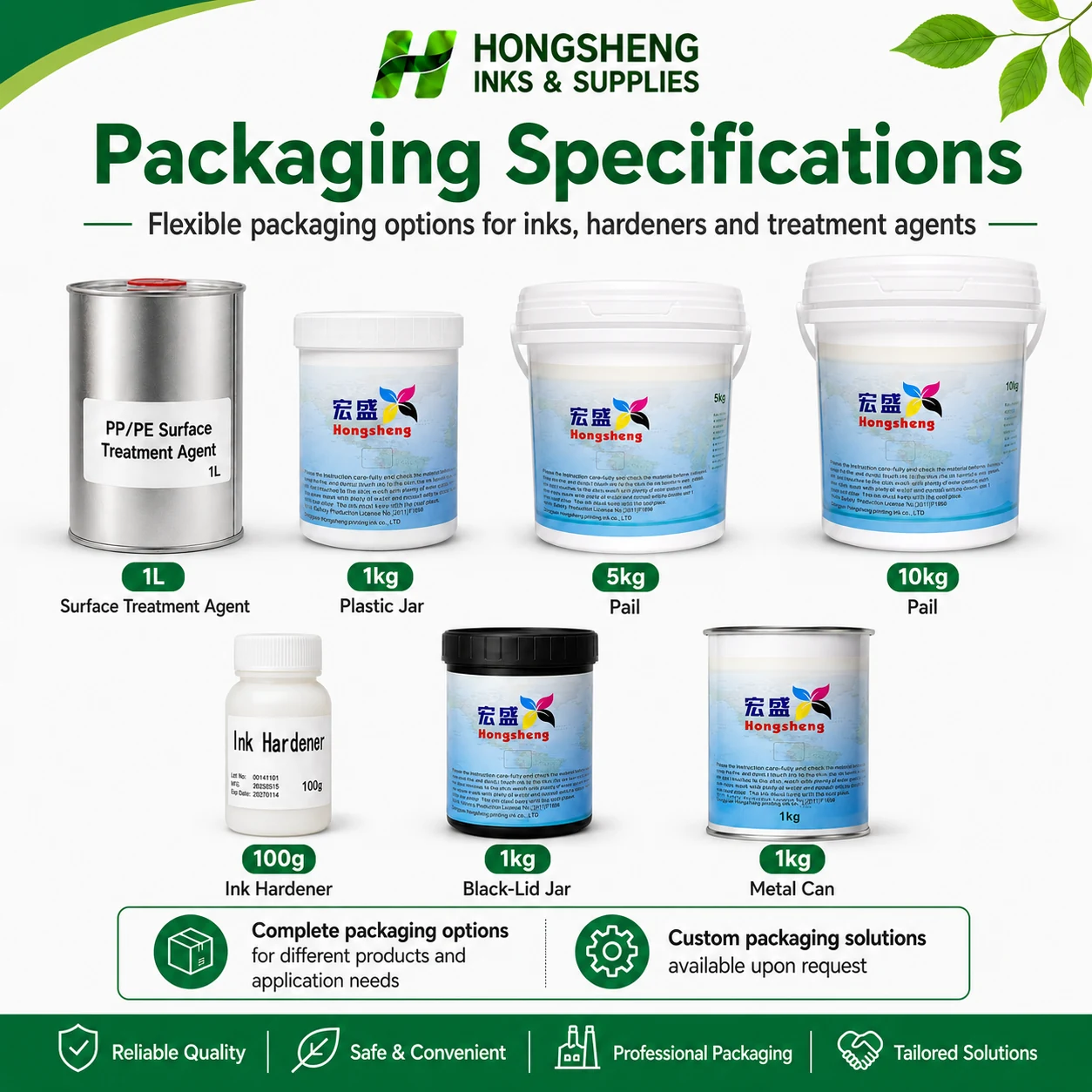
Packaging options

1 kgPlastic jarStandard package
5 kgPailGeneral packaging option
10 kgPailGeneral packaging option
CustomCustom packagingAvailability upon request
Hongsheng general packaging specifications
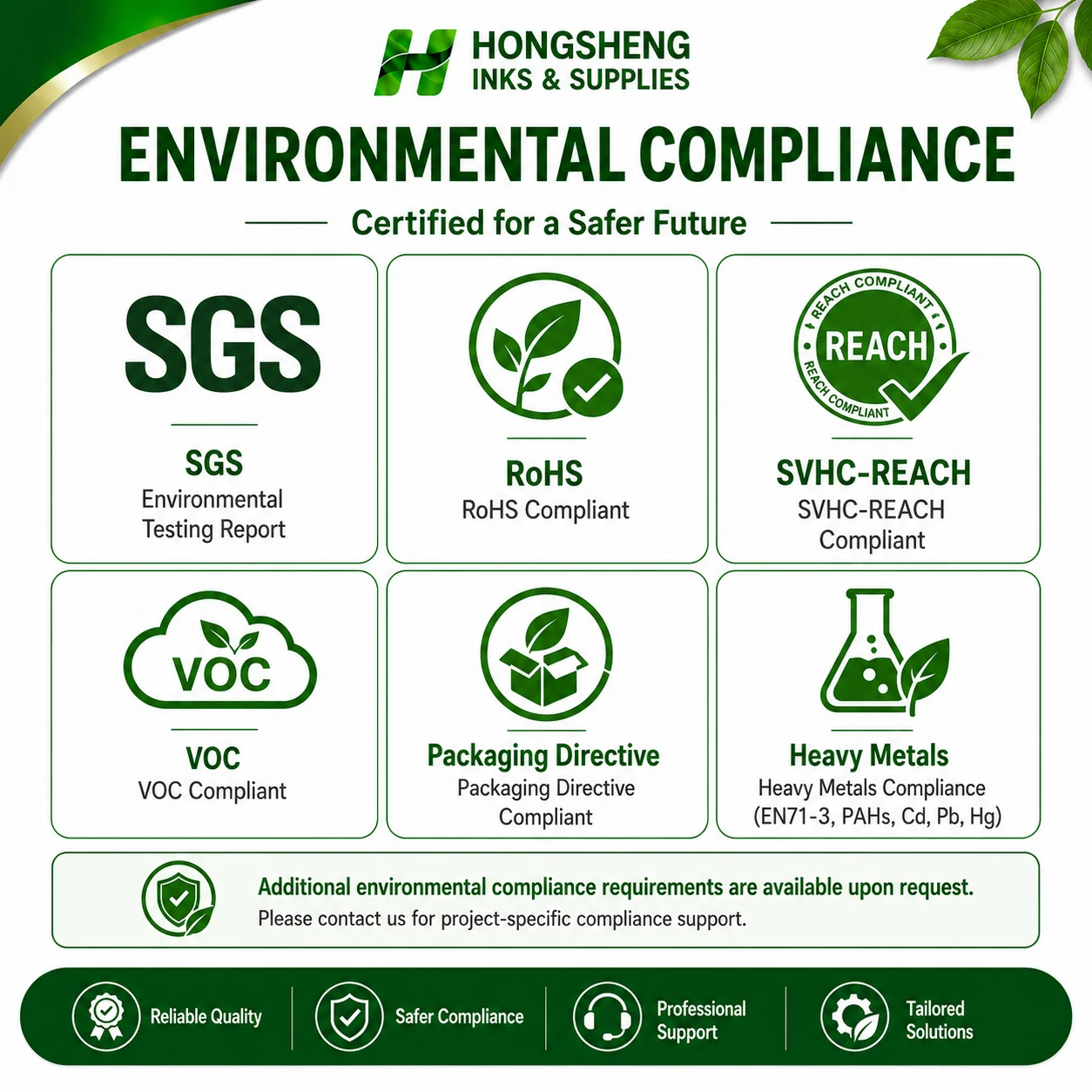
Hongsheng product compliance documentation scope

COMPLIANCE & DOCUMENTATION

Product documentation scope

The available documentation scope for this product includes the items shown below. Please identify the required color and destination market when requesting the applicable report.

  • Product- and color-specific compliance documentation is available upon request.
  • Confirm the destination market and required test scope before ordering.
Request Compliance Documents

APPLICATION EVALUATION

Information Helpful for Application Evaluation

Provide the available details below so Hongsheng can evaluate every real material, surface, drying process and durability requirement before recommending H698 or another suitable ink system.

  • Exact substrate or complete substrate list
  • Whether the project contains multiple materials
  • Plastic, PET, metal or coated surface
  • Resin grade, if known
  • Coating or plating information
  • Actual finished samples
  • Screen printing or pad printing
  • Screen mesh, where relevant
  • Ink color
  • Surface treatment, if any
  • Drying setup
  • Current adhesion problem
  • Required cross-cut or tape standard
  • Alcohol test requirement
  • Abrasion test requirement
  • Chemical or water-resistance requirement
  • Handling frequency
  • Whether one ink must serve several substrates
  • End-use environment
  • Customer acceptance criteria

TECHNICAL & CUSTOMIZATION SUPPORT

Support around the substrate, color and printing process

Custom Color Matching

Match the required appearance using the confirmed substrate and reference.

Formula Adjustment

Review adhesion, drying and resistance requirements together.

Compatibility Testing

Evaluate the actual substrate, treatment and printing conditions.

Printing Troubleshooting

Review leveling, edge definition, adhesion and drying issues.

Discuss Your Application

WHY CHOOSE HONGSHENG

Focused support for industrial printing projects

Customized formulationSubstrate testing supportFlexible packaging supportConsistent product performance
Learn More About Hongsheng →