Glass & Metal Decoration Ink Series

H92

H92 Heat Resistant & Weatherfast Metal Ink

A glossy, heat-curing screen printing ink for metal substrates requiring high-temperature resistance, salt-spray resistance and long-term outdoor durability.

Heat ResistanceWeather DurabilitySalt Spray ResistanceStrong Adhesion
Printing Method
Screen Printing & Pad Printing
Recommended Substrates
Stainless Steel · Aluminum · Tinplate · Coated Metal · Appliance Panels · Metal Nameplates · Automotive Components
Printing MethodScreen Printing & Pad Printing
Ink TypeHeat-curing metal ink
Component TypeSingle-component
Curing Method180–250°C baking for at least 30 min
Recommended SubstratesStainless Steel · Aluminum · Tinplate · Coated Metal
Main ApplicationOutdoor and high-temperature metal decoration

PRODUCT SUMMARY

H92 at a Glance

Application Focus
Metal printing for high-temperature and weather-exposed end use
Printing Methods
Screen printing and pad printing
Performance Focus
Heat resistance, weather resistance, adhesion and durability
Temperature Check
Production baking and service temperature must be evaluated separately
Validation
Actual finished-part and service-condition testing is recommended

KEY PERFORMANCE

Performance built around the printed finish

01

Heat Resistance

Color-dependent heat resistance up to 260°C after proper baking.

02

Weather Durability

Grade 7 or above in the stated weathering evaluation.

03

Salt Spray Resistance

No visible corrosion under the stated 5% NaCl spray test.

04

Strong Adhesion

100/100 squares retained under the stated cross-cut test.

RECOMMENDED SUBSTRATES

Confirmed compatible materials

Performance depends on substrate, surface treatment, printing process and drying or curing conditions. Substrate testing is required before production.

Stainless SteelAluminumTinplateCoated MetalAppliance PanelsMetal NameplatesAutomotive Components

METAL & END-USE CONDITIONS

Printing on Metal for High-Temperature & Weather-Exposed Applications

What ink is suitable for metal exposed to high temperatures?
Select an ink using the exact metal, surface finish, screen or pad printing process, production curing conditions, actual service temperature, exposure duration, adhesion requirement and customer test standard. Hongsheng H92 can be evaluated for confirmed compatible metal applications requiring documented heat-resistance performance.
What printing ink can be used on outdoor metal parts?
Outdoor selection depends on the exact metal, coating or finish, curing process, heat, sunlight, moisture and other weather exposure, required service duration and customer-specific tests. A documented weather-resistance claim still requires validation on the actual finished part.
What should be considered when printed metal needs weather resistance?
Define indoor or outdoor use, exposure to sunlight and moisture, service environment, actual metal and finish, adhesion requirement, other resistance requirements and the required weathering method before selecting the ink.
How do I choose ink for metal parts exposed to heat and outdoor conditions?
Evaluate heat and weather requirements together. Confirm the substrate and finish, screen or pad printing method, curing process, actual service condition, continuous or intermittent heat exposure, outdoor environment and required durability tests.
What information is needed before selecting ink for high-temperature metal use?
Provide the exact part, substrate and finish, production curing setup, actual service temperature, exposure pattern and duration, indoor or outdoor environment, adhesion target, resistance requirements and customer test standard. H92 is not automatically suitable for every metal or temperature range.

HEAT-EXPOSURE DIAGNOSIS

Common Printing Problems on Heat-Exposed Metal

Why does printed ink lose adhesion after heat exposure?
Possible factors include the exact metal, coating or surface finish, contamination, curing conditions, actual service temperature, exposure duration and ink-to-substrate compatibility. Diagnose the complete application rather than assuming one universal cause.
Why can a print look acceptable initially but fail after high-temperature use?
Initial appearance and initial adhesion do not prove long-term heat durability. The actual substrate, curing process, service condition and required heat-resistance test must be evaluated after the specified exposure.
Why can performance differ between different metal finishes?
Coated, plated and other finished metal surfaces can interact differently with the ink. Approval should be based on representative finished parts using the required production and end-use tests.
Why can heat exposure change print performance?
Performance can vary with service temperature, exposure duration, substrate or coating, ink-film condition, production curing and the end-use environment. These factors should be reproduced in the validation plan where practical.

TEMPERATURE CLARIFICATION

Heat Resistance vs. Baking Temperature: What Buyers Should Confirm

Is curing temperature the same as service temperature?
No. Curing or baking temperature is the production condition used to cure the printed ink. Service temperature is the temperature the finished printed part experiences during use. They must be defined and assessed separately.
If an ink is baked at high temperature, does that automatically mean it is heat resistant in use?
No. A high production baking temperature does not by itself prove resistance at a particular end-use temperature. Service performance depends on the ink, color, substrate, finish, exposure pattern and required test method.
What temperature information should buyers provide?
Provide both the production baking condition and the actual end-use condition. For service exposure, identify the temperature, whether exposure is continuous or intermittent, and its duration.
Should heat resistance be evaluated by temperature only?
No. The substrate and finish, ink color, exposure duration, continuous or intermittent operation, surrounding environment and customer test method also affect the evaluation.

H92 production baking data and its documented color-dependent heat-resistance references describe different technical conditions. Neither should be substituted for the other when defining an application.

OUTDOOR EVALUATION

Weather Resistance & Outdoor Durability

What should be considered when printed metal is used outdoors?
Confirm the exact metal and finish, sunlight, moisture, water, heat and other environmental exposure, expected service duration, adhesion requirement and customer weathering method.
Why can outdoor exposure affect printed metal?
Outdoor parts can experience combined sunlight, moisture, temperature variation and other service conditions. The finished substrate, coating, ink film and complete production process should be included in the durability evaluation.
What should buyers confirm when weather resistance is required?
Define the end-use environment, required weathering or lightfastness method, acceptance criteria, duration, substrate and finish, then compare those requirements with H92's documented reference performance.
Is weather resistant the same for every application?
No. Indoor and outdoor environments, sunlight and moisture exposure, service duration, substrate, coating and customer test standards differ. A general weather-resistance description does not guarantee every outdoor application.

PERFORMANCE VERIFICATION

Meeting Heat, Adhesion & Resistance Requirements

What should be tested before using ink on high-temperature metal parts?
Confirm initial adhesion and the required adhesion, appearance and resistance performance after the specified service-temperature exposure on representative finished parts.
How should adhesion be checked after heat exposure?
Use the customer's required adhesion method after reproducing the defined heat exposure and any specified conditioning. Compare the result with the documented H92 reference and the customer's acceptance criteria.
What should buyers confirm when weather resistance is required?
Confirm the required weathering or lightfastness method, environment, duration and acceptance criteria, then validate the printed finished part under the agreed conditions.
What should be checked if water or chemical resistance is also required?
Define the liquid or chemical, concentration where relevant, exposure method and duration, test state and acceptance criteria. Do not infer water or chemical resistance from heat performance alone.
What should be validated before mass production?
Follow the sequence: customer service condition, required test method, documented H92 reference performance, and actual-part validation under representative production conditions.

DOCUMENTED PERFORMANCE

Documented Test Reference

RequirementDocumented H92 Reference
Production bakingActual workpiece temperature of 180–250°C for at least 30 minutes
Adhesion100/100 squares retained · 1 mm cross-cut; 3M tape peel
Heat resistanceNo visible change · Up to 260°C after proper baking; varies by color
Weather resistanceGrade 7 or above · Lightfastness / weathering evaluation
Salt-spray resistanceNo visible corrosion · 5% NaCl spray test
Abrasion resistanceNo visible wear · Manual rubbing test
Water resistanceNo visible change · Water immersion test
Chemical resistanceNo visible change · Alcohol and cleaning-agent rubbing test

These are documented H92 references, not universal service guarantees. Heat resistance varies by color, and customer-specific service temperature, exposure duration, substrate, finish and test method require actual-part validation.

PRODUCT SELECTION

How to Choose Ink for High-Temperature Metal Applications

What should buyers compare when choosing heat-resistant metal ink?
Compare the exact substrate, coating or finish, screen or pad printing method, curing process, actual service temperature, continuous or intermittent heat exposure, duration, weather exposure, adhesion and resistance requirements, customer test method and available technical support.
How should buyers choose ink for outdoor metal products?
Evaluate the actual metal and finish, production curing, heat exposure, outdoor environment, moisture and weather exposure, adhesion requirement and durability test. A weather-resistant ink is not automatically suitable for every outdoor application.
How should buyers evaluate cost-effectiveness?
Total production cost can include ink consumption, curing energy and time, throughput, rejection, rework, adhesion stability, heat and weather durability and technical support. Hongsheng can review the application conditions before recommending H92 or another suitable metal ink system.

DIAGNOSTIC PATH

High-Temperature Metal Printing Troubleshooting

  1. 1
    Identify the exact metal substrate

    Confirm the substrate is within the documented H92 metal scope.

  2. 2
    Identify the surface finish

    Record the coating, plating or other relevant finished-surface information.

  3. 3
    Confirm the printing method

    Verify the documented screen or pad printing process and the actual production setup.

  4. 4
    Verify production curing

    Measure the actual workpiece baking condition separately from any end-use temperature.

  5. 5
    Define actual service temperature

    Record the temperature experienced by the printed part during use; do not substitute the oven setting.

  6. 6
    Define the heat-exposure pattern

    Confirm whether exposure is continuous or intermittent and record its duration where known.

  7. 7
    Define weather or outdoor exposure

    Record sunlight, moisture, water and other relevant service-environment conditions.

  8. 8
    Verify initial adhesion

    Test the representative finished part using the required adhesion method.

  9. 9
    Verify durability after exposure

    Repeat the required adhesion and durability checks after the defined heat or weather exposure.

  10. 10
    Run other required resistance tests

    Complete water, chemical, salt-spray or other customer-required tests where applicable.

  11. 11
    Select the appropriate Hongsheng system

    Use H92 only where the substrate, process and verified performance scope fit; otherwise request evaluation of another ink system or formulation.

APPLICATION BOUNDARIES

When H92 May Not Be the Right Ink

H92 is not automatically the best choice for every metal application. Where ordinary indoor adhesion is the primary requirement, a high-temperature and weather-resistant system may not be necessary. Different coatings and platings require actual-part testing.

Clarify whether the requirement concerns production curing temperature or end-use heat resistance. Do not recommend H92 automatically when the actual service temperature or outdoor exposure falls outside its verified performance scope, or when the substrate, printing process or customer test requirement is not confirmed. Hongsheng should evaluate another suitable metal ink system where needed.

TECHNICAL INFORMATION

Technical Information

Key reference data for product selection and printing evaluation.

Product Type
Glossy, heat-curing metal screen printing ink
Printing Method
Screen Printing & Pad Printing
Recommended Substrates
Stainless steel, aluminum, tinplate, coated metal, appliance panels, metal nameplates and automotive components
Component Type
Single-component
Baking Conditions
Actual workpiece temperature of 180–250°C for at least 30 minutes
Screen Mesh
100–130T
Adhesion
100/100 squares retained · 1 mm cross-cut; 3M tape peel
Heat Resistance
No visible change · Up to 260°C after proper baking; varies by color
Weather Resistance
Grade 7 or above · Lightfastness / weathering evaluation
Salt Spray Resistance
No visible corrosion · 5% NaCl spray test
View Additional Test Data
9002 White
250°C · Lightfastness Grade 7–8
9021 Medium Yellow
260°C · Lightfastness Grade 7
9023 Primary Yellow
200°C · Lightfastness Grade 7–8
9032 Bright Red
220°C · Lightfastness Grade 7
9048 Cyan Blue
200°C · Lightfastness Grade 7–8
9035 Orange Red
220°C · Lightfastness Grade 7–8
9061 Green
200°C · Lightfastness Grade 7–8
9038 Pink
250°C · Lightfastness Grade 7–8
Abrasion Resistance
No visible wear · Manual rubbing test
Water Resistance
No visible change · Water immersion test
Chemical Resistance
No visible change · Alcohol and cleaning-agent rubbing test

Test results are for reference only. Actual performance depends on substrate, surface treatment, printing process and drying or curing conditions.

Technical notes
  • Remove dust, oil and other surface contaminants before printing.
  • Conduct a production trial on the actual substrate before mass printing.
  • Performance varies with substrate, coating chemistry, film thickness and actual workpiece temperature.
  • Shelf life: 12 months from manufacture in unopened original packaging; re-test expired material.

STANDARD COLORS & SPECIAL EFFECTS

Catalog Color Range

Standard, metallic, fluorescent and transparent colors shown in the catalog are available as reference options. Final appearance must be confirmed on the actual substrate.

PACKAGING OPTIONS
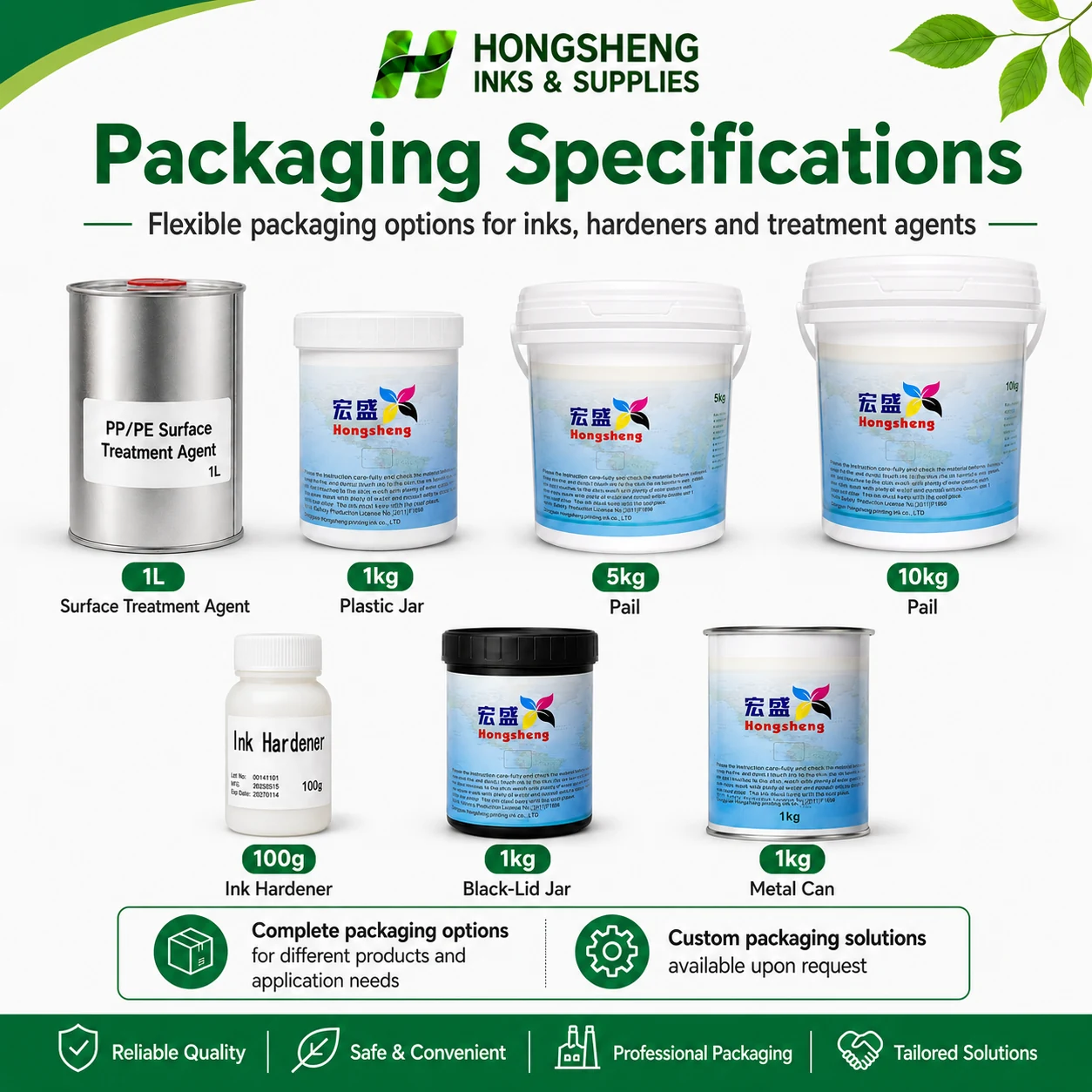
Packaging options

1 kgStandard package
5 kgPailUpon request
10 kgPailUpon request
CustomCustom packagingUpon request
Hongsheng general packaging specifications
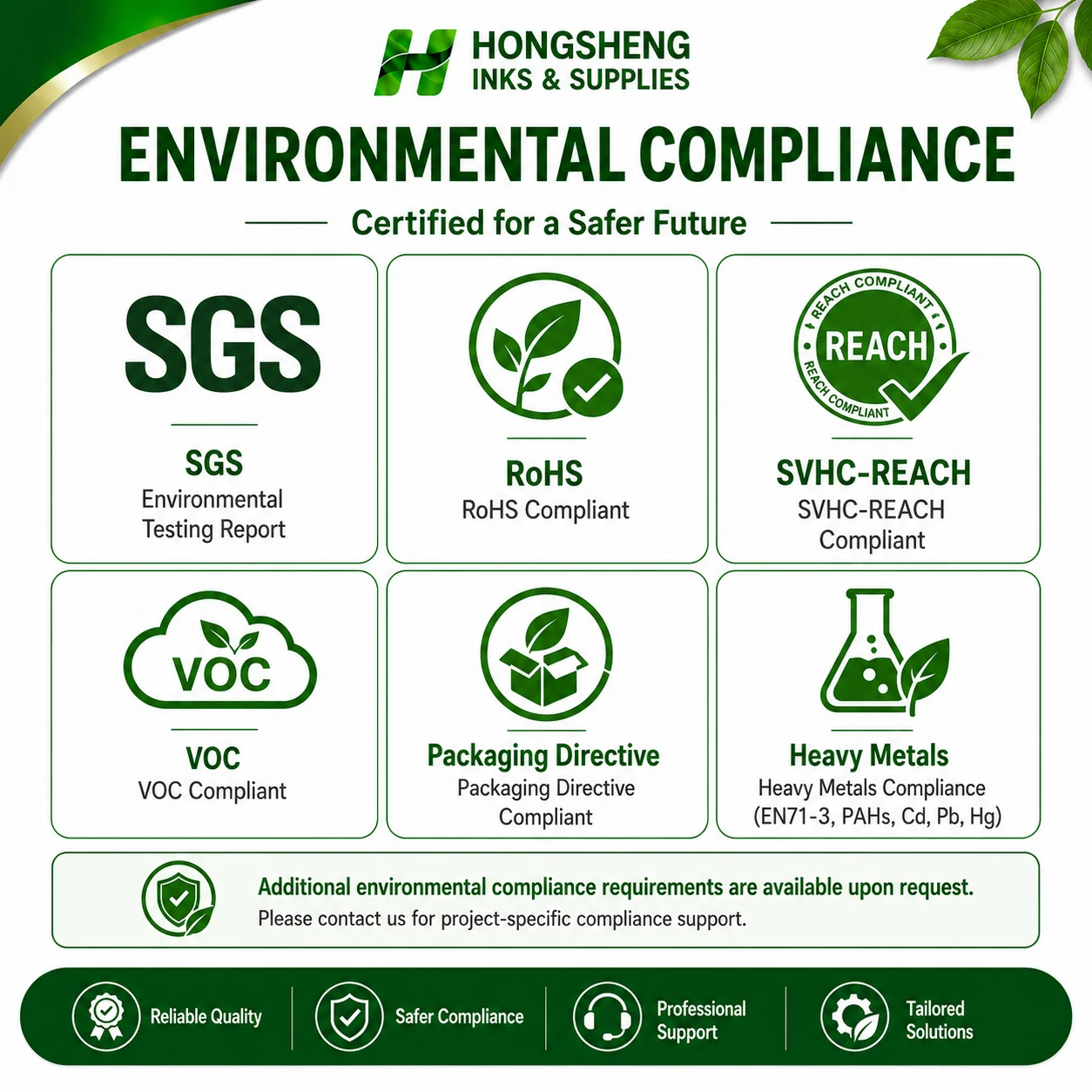
Hongsheng product compliance documentation scope

COMPLIANCE & DOCUMENTATION

Product documentation scope

The available documentation scope for this product includes the items shown below. Please identify the required color and destination market when requesting the applicable report.

  • Product- and color-specific compliance documentation is available upon request.
  • Confirm the required regulation, test method, color and target market before ordering.
Request Compliance Documents

APPLICATION EVALUATION

Information Helpful for Application Evaluation

Provide the available details below so Hongsheng can distinguish production curing from actual service conditions and evaluate H92 or another suitable metal ink system without promising results before testing.

  • Exact metal type
  • Coating, plating, anodizing or surface finish
  • Actual finished part
  • Screen-printing or pad-printing setup
  • Production curing or drying setup
  • Ink color
  • Actual service temperature
  • Continuous or intermittent heat exposure
  • Heat-exposure duration
  • Indoor or outdoor use
  • Weather, sunlight or moisture exposure
  • Current failure mode
  • Adhesion requirement
  • Heat-resistance requirement
  • Weather-resistance requirement
  • Water or chemical-resistance requirement
  • Customer test standard
  • Expected end-use environment

TECHNICAL & CUSTOMIZATION SUPPORT

Support around the substrate, color and printing process

Custom Color Matching

Match the required appearance using the confirmed substrate and reference.

Formula Adjustment

Review adhesion, drying and resistance requirements together.

Compatibility Testing

Evaluate the actual substrate, treatment and printing conditions.

Printing Troubleshooting

Review leveling, edge definition, adhesion and drying issues.

Discuss Your Application

WHY CHOOSE HONGSHENG

Focused support for industrial printing projects

Customized formulationSubstrate testing supportFlexible packaging supportConsistent product performance
Learn More About Hongsheng →