Printing on glass-fiber-reinforced nylon can be challenging even when the first print looks acceptable. On PA6+GF and PA66+GF molded parts, markings may lose adhesion, smear during alcohol wiping, or wear away after repeated contact. Such failures can affect the appearance and legibility of industrial labels, symbols, and decorative graphics.
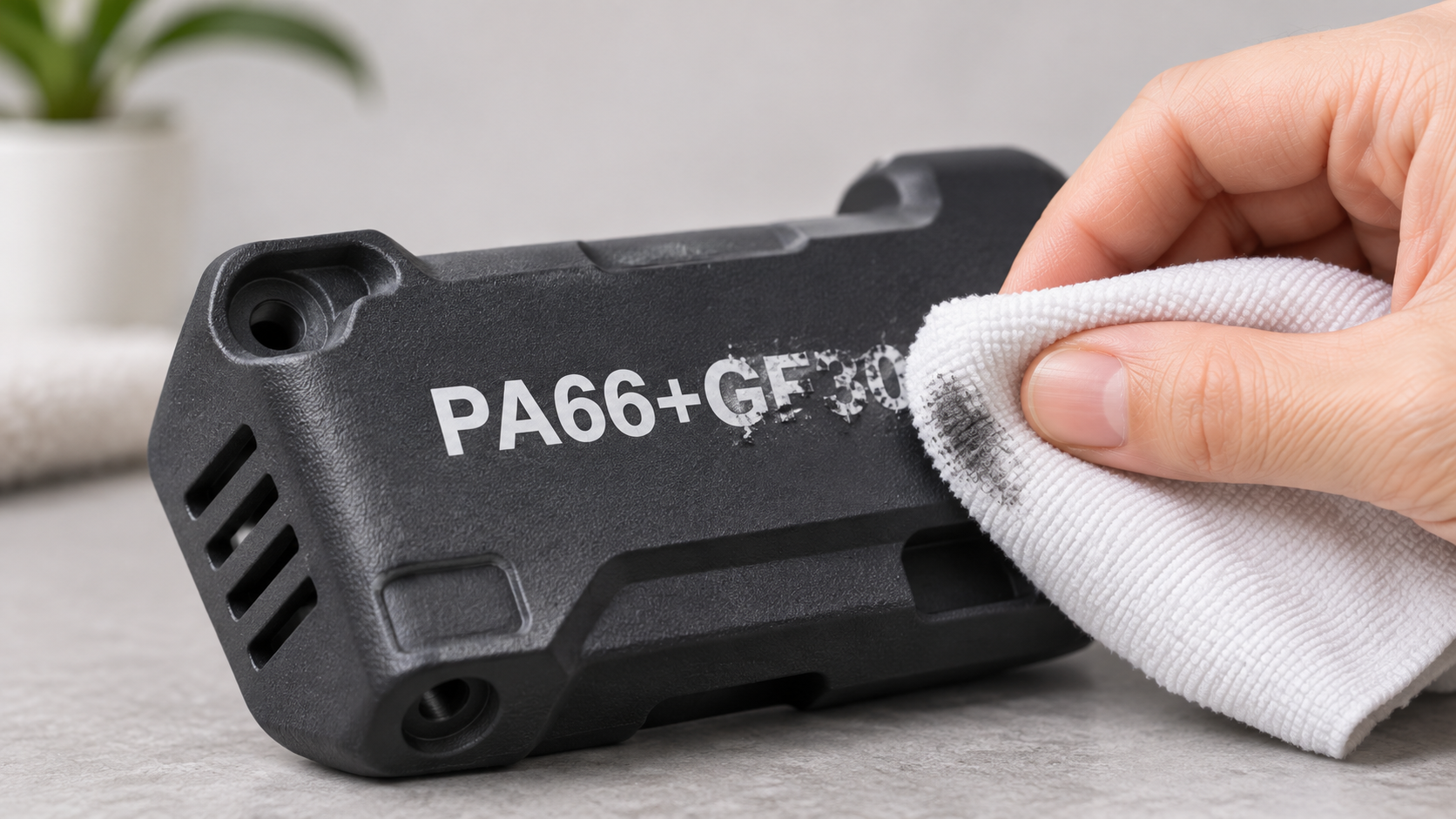
A suitable ink must work with the actual molded surface and meet more than one performance requirement. Initial adhesion, alcohol resistance, and abrasion resistance are related, but they are not interchangeable. This article explains the causes of print failure and how to evaluate a solvent-based ink solution before production.
1. Common Printing Problems on Glass-Filled Nylon
1.1 Unstable adhesion across parts or batches
The same ink may adhere well to one glass-filled nylon part but show edge lifting or local peeling on another. A successful first print does not necessarily mean the ink will behave consistently across different material grades, batches, or molding conditions.
1.2 Smearing or ink loss during alcohol wiping
Alcohol-based cleaning or inspection can expose limitations in an ink film. Depending on the ink formulation and the wiping conditions, the print may soften, discolor, lose gloss, or transfer onto the wiping material. This is a separate concern from initial adhesion.
1.3 Printed graphics wearing away during handling
Printed symbols may experience friction during assembly, packaging, transportation, or routine use. If the ink system is not suited to those conditions, the image can gradually abrade or become partially removed. The required level of wear resistance depends on the final application.
2. Why Does Ink Adhesion Vary on PA6+GF and PA66+GF?
Glass-filled nylon is not a single, uniform printing surface. PA6 and PA66 are different polyamide materials, while the percentage and distribution of glass fiber, compounded additives, and injection-molding conditions can influence the surface presented to the ink.
2.1 Glass fiber distribution and molded surface texture
Differences in fiber exposure, surface roughness, and local resin coverage may change how consistently ink wets and bonds to the part. Glass fiber content alone cannot predict adhesion: two components with a similar nominal GF percentage may print differently.
2.2 Release agents, oils, and other residues
Mold-release residues, oils, dust, and handling contamination can interfere with ink contact. Surface preparation should therefore be evaluated on representative production parts. Cleaning methods must also be compatible with the nylon material and its finish.
2.3 Moisture condition and process variation
Polyamides absorb moisture, and the condition of molded components may vary with storage and processing. Together with differences in molding temperature, mold condition, and material formulation, these variables can contribute to printing inconsistency. Their actual effect should be assessed rather than assumed.
Practical implication: test the ink on the customer’s actual PA6+GF or PA66+GF component, not only on a generic nylon test panel.
3. Adhesion, Alcohol Resistance, and Abrasion Resistance Are Different
An ink may pass an initial adhesion check and still fail after a solvent wipe or repeated rubbing. Each requirement should be evaluated independently under agreed test conditions.
| Property | What the test needs to establish |
|---|---|
| Adhesion | Whether the ink film remains bonded to the specified PA+GF surface. |
| Alcohol resistance | Whether wiping with a defined alcohol and method changes the printed film or appearance. |
| Abrasion resistance | Whether repeated contact or rubbing damages or removes the printed markings. |
A reliable selection decision considers the full performance profile rather than treating one passing test as evidence of overall durability.
4. Hongsheng H698 Ink Solution for Glass-Filled Nylon
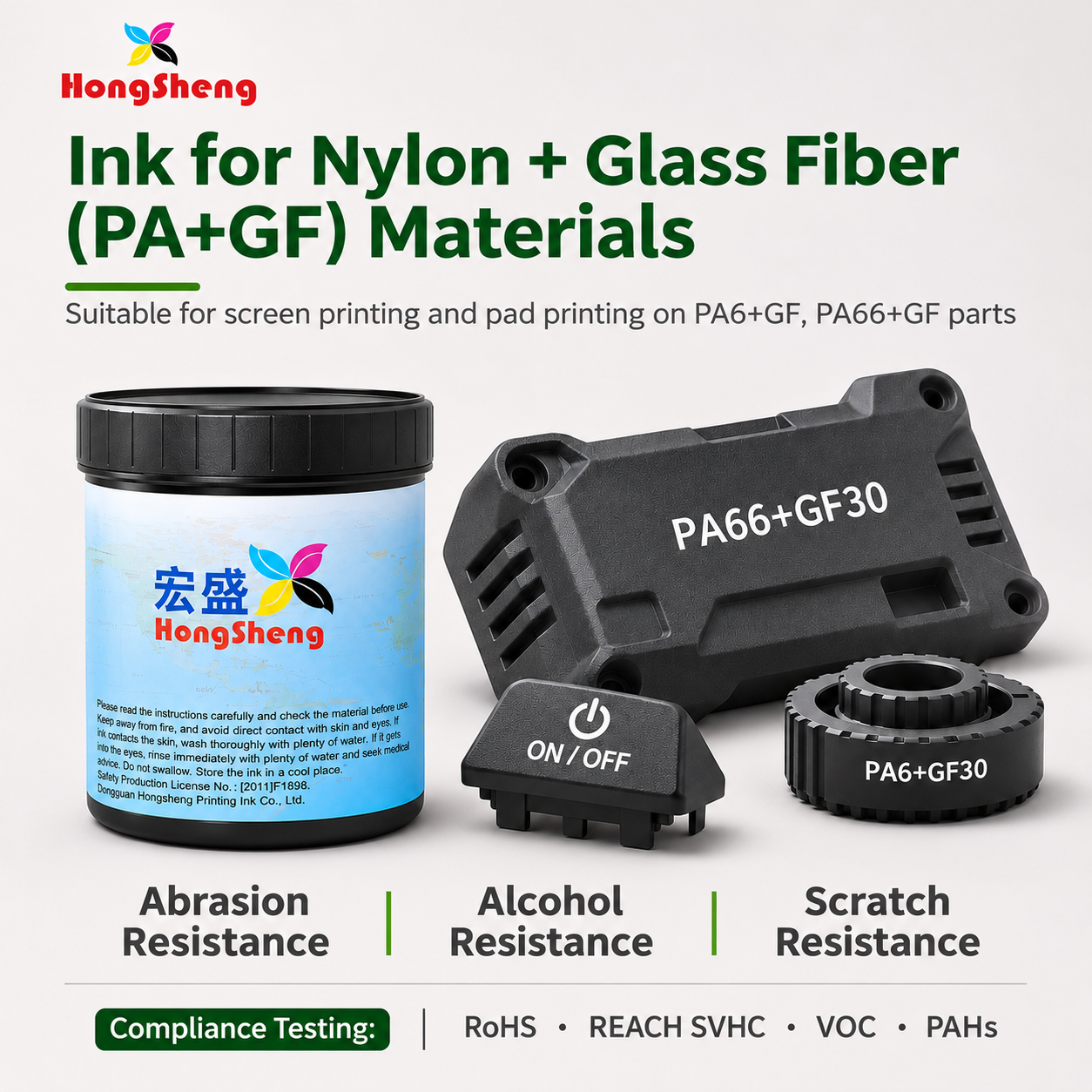
Hongsheng H698 Special Abrasion Resistant Universal Ink is an existing solvent-based ink for screen printing and pad printing. Hongsheng confirms that H698 has been evaluated on glass-filled PA6+GF and PA66+GF components for adhesion, alcohol-wiping and abrasion requirements. H698 is the product solution discussed in this article.
The starting point is the actual molded surface: performance on one glass-filled nylon grade or batch does not automatically extend to another. Customers can first test the existing H698 product on their production parts and review the results against their specified requirements.
What should be checked when evaluating H698?
- Substrate compatibility: confirm H698 adhesion on the actual PA6+GF or PA66+GF part, including its molded finish and surface condition.
- Performance requirements: evaluate alcohol wiping and abrasion resistance with the customer’s stated conditions and acceptance criteria.
- Printing and drying: confirm screen or pad printing transfer, ink deposit, and complete drying before final testing.
- Color and appearance: select the required marking color and finish; additional adjustments can be considered if a special requirement remains.
H698 has been evaluated on PA6+GF and PA66+GF materials. The exact nylon-specific test protocols and quantitative results are not reproduced here. Performance must be confirmed on the customer’s actual material; a successful result on one part does not guarantee identical performance across every grade or production batch.
5. How to Evaluate Ink Performance on Glass-Filled Nylon Parts
Before mass production, use actual molded parts and production-representative printing conditions. Define the test method and acceptance criteria with the customer in advance.
Step 1 — Confirm substrate and surface condition
Record whether the part is PA6+GF or PA66+GF, the known material grade or GF content, its surface finish, and any cleaning or molding-related residues. Where adhesion varies between batches, compare parts from more than one batch.
Step 2 — Print and dry according to the selected ink system
Use the intended screen or pad printing conditions. Allow the solvent-based ink to dry or cure as required by its formulation before judging final performance. Avoid comparing samples with different drying histories.
Step 3 — Test the requirements separately
- Adhesion: perform the agreed adhesion method and inspect for lifting or peeling.
- Alcohol wiping: define the alcohol type, concentration, contact time, wiping method, and applied force.
- Abrasion: define the contact material, force, number of cycles, and acceptable change in appearance.
Step 4 — Review appearance and repeatability
Inspect printed edges, fine characters, gloss, and any ink transfer or surface damage. Confirm whether results remain consistent across representative parts and batches before approving a production solution.
6. Typical Industrial Applications
Glass-filled polyamide components are used across industries where stiffness, mechanical performance, or dimensional requirements matter. Printing needs vary by the location and purpose of the markings. Potential applications for evaluation include:
- Automotive components: identifiers or decorative markings on selected glass-filled nylon parts.
- Electrical and electronic products: symbols, labels, and graphics on molded housings or components.
- Small household appliances: markings on compatible reinforced-nylon parts or controls.
- Industrial equipment and tools: identification, instructions, or functional graphics on plastic components.
These examples describe possible application areas, not a claim that a specific formulation has been validated in every industry or on every component.
7. Frequently Asked Questions
What ink is suitable for printing on glass-filled PA6 and PA66?
Hongsheng H698 is the solvent-based ink solution used for the glass-filled PA6 and PA66 applications described here. It supports screen and pad printing evaluation where adhesion, alcohol resistance and abrasion resistance are required. Verify the final performance on actual molded components under the customer’s production and test conditions.
Why does ink adhesion vary between different PA66+GF parts?
Even with a similar material designation, differences in additives, exposed fiber, molding conditions, surface residues, and handling may affect print performance. Comparing actual batches and surface conditions can help identify the source of inconsistent adhesion.
Can printing ink resist alcohol wiping on glass-filled nylon?
Yes, with a suitable ink and validated conditions. Hongsheng has evaluated H698 on glass-filled PA6 and PA66 applications where alcohol-wiping performance matters. The result depends on the molded surface, complete drying, alcohol type and concentration, wiping pressure, test duration and acceptance criteria; initial adhesion alone is not sufficient.
Does good ink adhesion guarantee abrasion resistance?
No. Adhesion concerns the bond between ink and substrate, whereas abrasion resistance concerns damage caused by repeated mechanical contact. An ink may adhere well initially yet lose printed detail during a rubbing test. Both properties should be assessed separately.
Does glass fiber content affect printing ink adhesion?
It can influence surface texture and fiber exposure, which may affect printing consistency. However, a higher glass fiber percentage does not automatically mean worse adhesion. The resin, additives, molding conditions, and final surface must be considered together.
How should ink be tested before mass production on PA+GF parts?
Print on actual PA6+GF or PA66+GF parts using the intended process, follow the required drying conditions, and then test adhesion, alcohol wiping, and abrasion separately. Document the methods, sample conditions, and acceptance limits, and check repeatability across representative parts.
8. Conclusion
Reliable printing on glass-filled nylon requires more than an ink that initially sticks to the surface. Differences between PA6+GF and PA66+GF parts, molding and surface conditions, alcohol exposure, and mechanical wear all need attention. A solvent-based ink solution should be assessed for each required property on real production materials.
Hongsheng H698 offers an existing product option for PA6+GF and PA66+GF screen and pad printing applications. To evaluate it for your production, share the molded parts, print method and required adhesion, alcohol-wiping and abrasion tests. Further adjustment can be discussed only where the initial evaluation identifies a specific need.