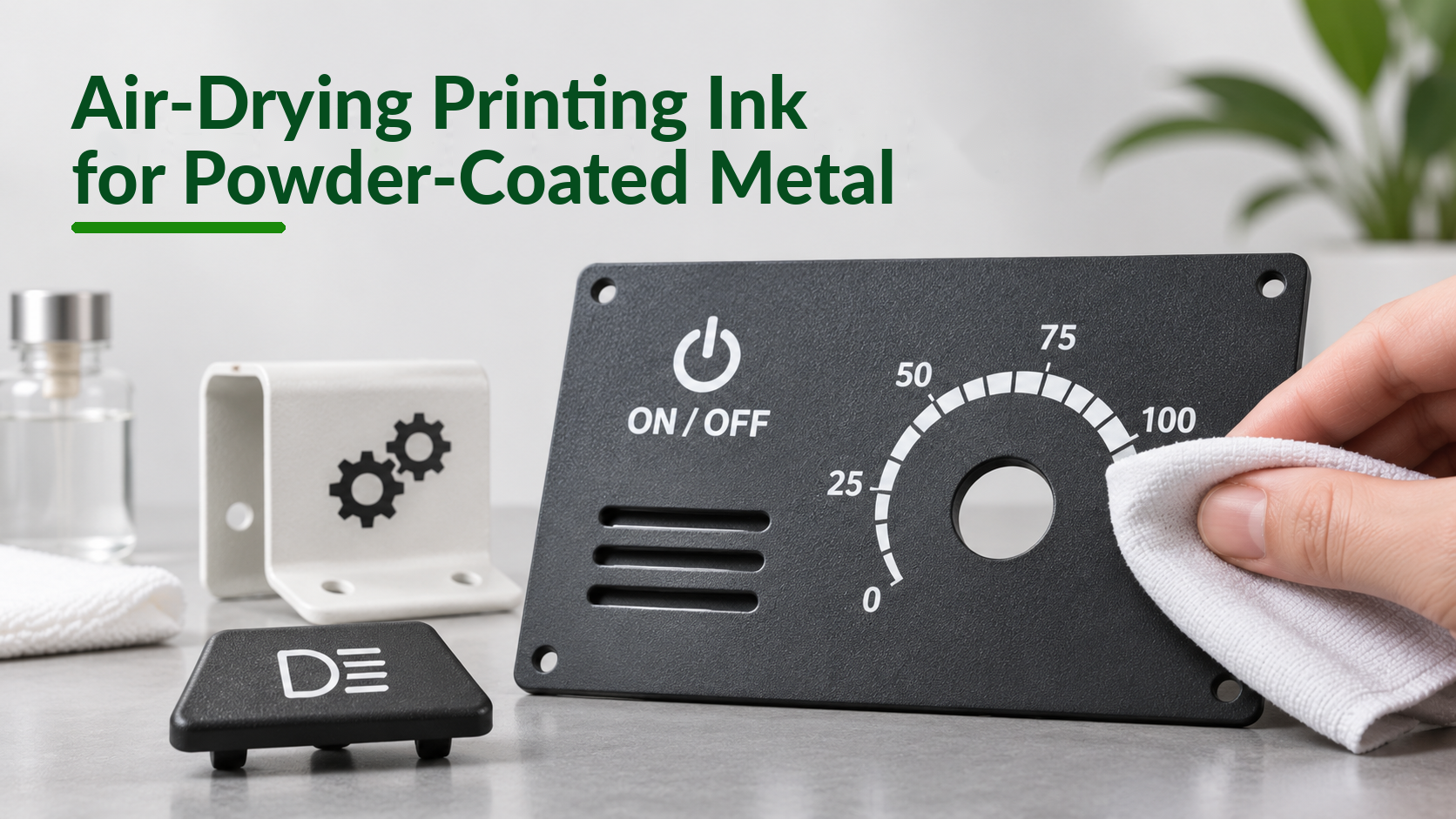
Printing on powder-coated metal is different from printing on bare metal. After powder coating, the ink contacts the cured coating layer rather than the steel or aluminum beneath it. An ink that adheres well to bare metal may still peel, smear or lose gloss on a powder-coated part, especially after wiping or chemical exposure.
For manufacturers printing logos, graduations, warnings or decorative graphics, reliable performance depends on both ink-to-coating compatibility and the conditions the finished part must withstand. This article explains the common failure mechanisms, how to evaluate solvent resistance and when Hongsheng H665 may be considered as an existing product solution.
1. Common Printing Problems on Powder-Coated Metal
Ink peeling or unstable adhesion
A printed marking may initially look normal but lift during tape testing, handling or use. This often indicates that the ink and the actual powder coating have not been adequately matched, or that the surface and drying conditions need attention.
Damage after gasoline contact
Some machinery parts, housings and industrial containers may encounter gasoline during service or cleaning. Depending on the liquid composition and exposure, an unsuitable ink film can soften, lose gloss, smear or separate from the coating. Brief wiping and prolonged liquid contact are not equivalent tests.
Alcohol wiping, discoloration and abrasion
Alcohol cleaning or repeated rubbing may reveal poor solvent resistance, incomplete drying or insufficient film durability. Ink may transfer onto a cloth, become dull, or wear away even when the initial print appears firmly attached.
Additional drying or baking steps
Some printing systems require a separate thermal process. For an already powder-coated component, manufacturers often prefer an ink system that can complete its normal printing and drying workflow without another high-temperature bake. The powder coating itself must already have been properly cured by the coating supplier’s process.
2. Why Does Ink Adhere to Bare Metal but Peel Off Powder-Coated Surfaces?
Powder coatings can be based on epoxy, polyester or hybrid resin systems. Differences in resin chemistry, additives, surface texture and coating cure can change how well printing ink wets and bonds to the finished surface. The underlying metal type alone therefore cannot determine ink suitability.
A smooth, glossy finish may behave differently from a textured or matte coating. Oil, dust, silicone-containing residues or cleaning contamination can also interfere with wetting and adhesion. When printing performance changes between batches, compare the actual coating supplier, surface finish, cleaning method and curing history before concluding that the ink itself is defective.
The most useful starting point is a representative finished workpiece—not an uncoated metal coupon. Printing and evaluation should be carried out on the same coating and surface condition used in production.
3. Adhesion Is Not the Same as Gasoline, Alcohol or Abrasion Resistance
Good adhesion means the ink film remains bonded to the coating under a defined adhesion test. Chemical resistance asks a different question: whether the ink film retains its appearance and integrity after contact with a specified liquid. Abrasion resistance concerns the effect of repeated mechanical rubbing.
These properties need separate verification. Passing a tape or cross-cut test does not prove resistance to alcohol; passing an alcohol wipe test does not prove gasoline resistance; and a short gasoline wipe does not demonstrate suitability for continuous immersion.
For meaningful results, specify the exact chemical, its concentration or grade, the contact duration, wiping pressure or load, number of cycles where relevant, the drying state of the print and the acceptance criteria. Different customer tests may lead to different outcomes on the same coating.
4. Hongsheng H665 Ink Solution for Powder-Coated Metal
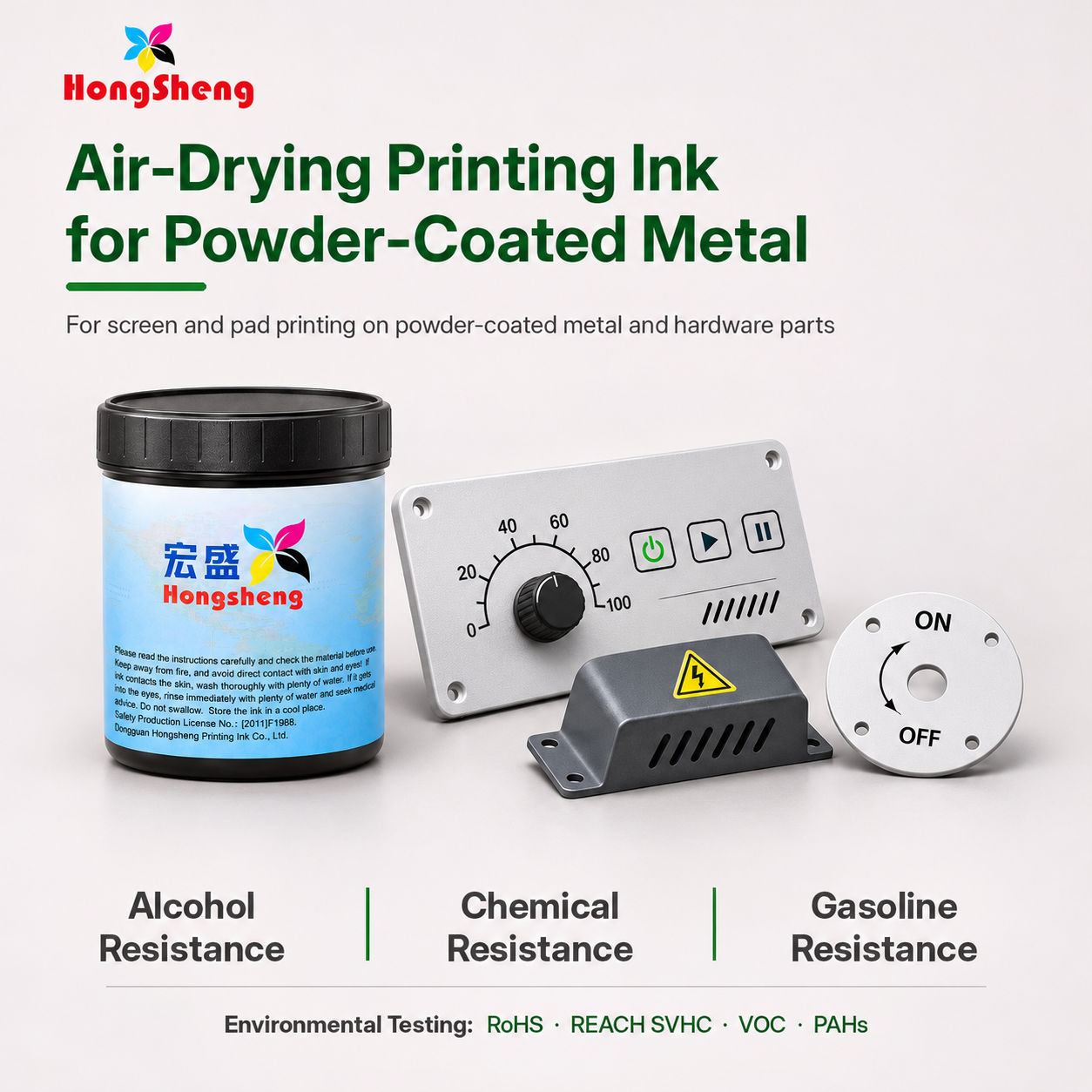
Hongsheng H665 is an existing solvent-based metal printing ink for screen printing and pad printing. It is a single-component, air-drying system designed for compatible metal and coated-metal surfaces, with adhesion, abrasion and common industrial solvent resistance among its documented performance areas.
For powder-coated parts, H665 can be evaluated as a practical starting option when the coating chemistry, printing process and customer resistance requirements are suitable. Its normal air-drying workflow can help avoid an additional ink-baking step in standard applications, while the finished print must still be allowed to dry fully before performance testing.
Where gasoline or a specific cleaning solvent is involved, suitability should be confirmed on the customer’s actual powder-coated part. General solvent-resistance results should not be treated as proof of resistance to every gasoline formulation, cleaning liquid or exposure method.
Product reference: H665 Single-Component Air-Drying Metal Ink
H665 can be assessed for printed logos, product labels, identification marks and decorative details on compatible powder-coated metal housings, panels and industrial parts. Final approval should follow the required adhesion and chemical-resistance tests on representative finished components.
5. Air Drying and Optional Curing-Agent Considerations
H665 is primarily positioned as an air-drying ink; it does not require a separate high-temperature ink bake in standard documented applications. However, surface drying and full drying are different stages. Tests performed before the film has reached its intended final drying condition may give misleading results.
For particular applications, a compatible curing agent may be considered only where Hongsheng has confirmed that it is suitable for the exact supplied ink formulation. The agent type, mixing ratio, usable working time, drying or curing schedule and final properties must be specified for that application. A curing agent must not be added to H665 arbitrarily, and adding one does not automatically guarantee improved resistance to every chemical.
For customers, the priority is to select the simplest verified process that meets the finished-part requirements. A standard H665 sample and actual-part evaluation should be considered before discussing further formula adjustments.
6. How to Test Printing Ink Before Mass Production
Performance should be assessed on representative powder-coated production parts using agreed methods and acceptance criteria. The following checks help identify the source of failures rather than relying only on a print’s initial appearance.
| Evaluation | What to define | What to examine |
|---|---|---|
| Surface compatibility | Powder coating type, finish, cleaning and print process | Ink wetting and adhesion on the actual coated part |
| Adhesion | Full drying state, tape/cross-cut method and acceptance rule | Lifting, flaking or ink loss |
| Alcohol resistance | Alcohol type/concentration, load, wiping method and cycles | Color transfer, softening, gloss change and adhesion |
| Gasoline / solvent | Exact liquid, contact time, wiping or immersion method | Swelling, smear, discoloration, gloss loss and peeling |
| Abrasion | Rubbing medium, pressure and repetition | Wear, print legibility and exposed substrate |
To make test results comparable, record the ink batch, coating sample, film thickness where known, ambient conditions, drying schedule and time between printing and testing. If a result fails, change only one process variable at a time and repeat the agreed test.
7. Frequently Asked Questions
Can powder-coated metal be screen-printed or pad-printed?
Yes. Printing is possible when the ink is compatible with the cured powder-coating surface. The actual coating chemistry, texture, cleanliness and drying conditions must be considered. A production-part trial is more reliable than assuming all powder coatings behave alike.
Why can ink work on bare metal but fail on a powder-coated part?
The ink bonds to different surfaces. On powder-coated metal it contacts the coating resin and any surface additives, not the base metal. Coating formulation, cure, texture and contamination can all affect wetting and adhesion.
Does H665 require high-temperature baking?
H665 is normally an air-drying ink for its documented applications, so an additional high-temperature ink bake is not required for standard use. The complete drying schedule must still be followed before adhesion and resistance testing.
Can a curing agent be added to H665?
A compatible curing agent may be evaluated when approved for the specific formulation and application. Do not use an arbitrary agent or mixing ratio. Request the applicable mixing, working-time and curing instructions before production.
Does alcohol resistance mean an ink will also resist gasoline?
No. Alcohol and gasoline differ chemically, and their effects depend on the specific ink film and exposure conditions. Gasoline resistance must be checked separately using the actual liquid, contact duration and customer acceptance criteria.
What should be sent to Hongsheng for ink selection?
Provide a powder-coated sample or coating specification, printing method, required color, current adhesion issue, drying capability and the exact alcohol, gasoline or solvent test conditions. These details help determine whether existing H665 is an appropriate candidate for testing.
8. Conclusion
Powder-coated metal printing problems cannot be solved by considering bare-metal adhesion alone. The printed ink must be compatible with the cured coating and must withstand the specific cleaning, chemical contact and abrasion conditions required by the finished part.
Hongsheng H665 offers an existing air-drying screen and pad printing ink option for suitable metal and coated-metal applications. The preferred next step is to test H665 on the customer’s actual powder-coated part, using agreed adhesion and resistance criteria. If the standard system does not meet a special requirement, further technical evaluation or formulation adjustment can be discussed.
Need to evaluate ink on your powder-coated component? Contact Hongsheng with your substrate and test requirements.